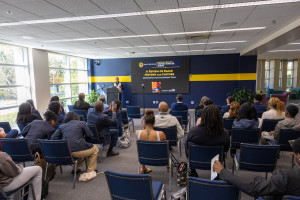
CHARLOTTE, N.C. / Oct. 27, 2026 – Author, archaeologist and cultural historian Anthony T. Browder shared more than three decades of research and firsthand experience in Egypt with students at Johnson C. Smith University during a lecture in the James B. Duke Memorial Library as part of the College of Liberal Arts Visiting Scholar Series.
Browder’s afternoon lecture offered students an opportunity to engage with the visiting scholar in a more intimate setting ahead of a longer presentation open to the public that evening in the New Science Center’s Truist Auditorium.
During his presentation, Browder emphasized the importance of studying African history through primary sources, archaeological evidence and direct engagement with the places where that history occurred. He also challenged students to question their assumptions and critically examine what they have been taught.
“We have to stop and ask ourselves, ‘Who taught us what we know, and what have I not been taught?’” Browder said. “And what is the impact of certain information being intentionally withheld from me?”
Throughout his presentation, Browder encouraged JCSU students to approach history with curiosity and rigor, challenging them to seek evidence and investigate sources for themselves.
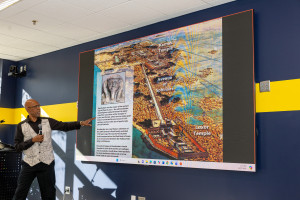
“The best trait that you could ever develop is the judicious sense to know what not to believe,” Browder told students. “If someone says something that sounds good, ask them, ‘Where is your evidence?’”
Browder has traveled to Egypt approximately 70 times and visited the African continent more than 90 times. Since 1987, he has led study tours that have taken more than 4,000 people to Egypt and West Africa.
“My education in the subject matter was an independent education that I gave myself,” he said.
Browder’s involvement in archaeology began when he met archaeologist Elena Pischikova, who was working to excavate tombs dating to Egypt’s 25th Dynasty, approximately 2,700 years ago. Pischikova had been funding the excavations herself, spending approximately $40,000 annually and exhausting her personal savings to continue the work.
Inspired by her dedication, Browder established the nonprofit ASA Restoration Project, named in honor of Dr. Asa G. Hilliard III, a mentor and influential figure in his life, to help raise the funds necessary to continue the excavations. However, Pischikova challenged him to do more than provide financial support.
“She told me, ‘You can’t just raise funds so that we can excavate these tombs. You need to be here and be actively involved in doing the archaeology,’” Browder recalled. “That’s how I became involved. I was pulled into this project doing hands-on groundwork.”
Beginning in 2009, Browder spent 15 years participating in the excavation and restoration project. He became the first African American to fund and co-direct an archaeological excavation in Egypt. According to Browder, the work has produced discoveries that have rewritten the history of the 25th Dynasty and expanded understanding of Kemet, the name by which ancient Egyptians referred to their country.
Browder explained that discoveries made during the excavations have helped researchers explore historical connections between civilizations of the Nile Valley and cultures across the African continent, particularly in West Africa.
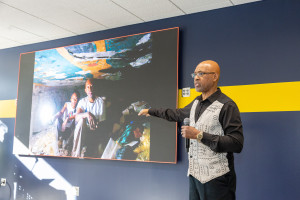
Exploring Caves with Atlantis
Among the sites excavated was the tomb of Karakhamun, a priest and official whose massive underground complex extends approximately 250 feet and was carved directly from limestone bedrock.
Browder shared photographs documenting the painstaking excavation process, including chambers filled with centuries of debris and a burial chamber containing a massive granite sarcophagus. He explained how the discoveries have contributed to research examining the movement of people, ideas and cultural traditions from the Nile Valley into West Africa.
For Browder, however, the work has also been deeply personal.
His daughter, Atlantis Browder, began traveling to Africa with him as a child and later joined him in Egypt as a participant in the archaeological project. During the lecture, Browder showed photographs of Atlantis descending a 30-foot shaft into a burial chamber and working alongside him approximately 70 feet underground.
“We spent six hours a day, six days, some 70 feet underground, going through the rubble, going through the debris, finding fragments of bodies, finding pieces of jewelry, pieces of gold,” Browder recalled.
That commitment now extends to another generation. Browder recently traveled to Egypt with his 2-year-old grandson, continuing a family tradition built around experiencing history firsthand.
Browder said he hopes students leave his lecture understanding that their lives matter and that they have a responsibility to use their knowledge to make a positive difference in their communities.
“In order to be a good citizen, you need to know yourself. You need to know history. You have to understand the power you possess and be willing to utilize that power to improve the quality of life for your children and your children’s children,” he said.