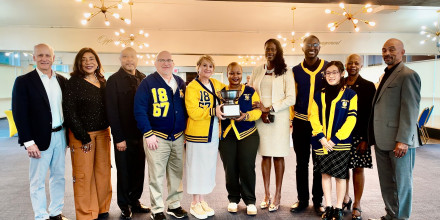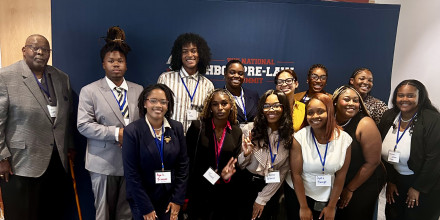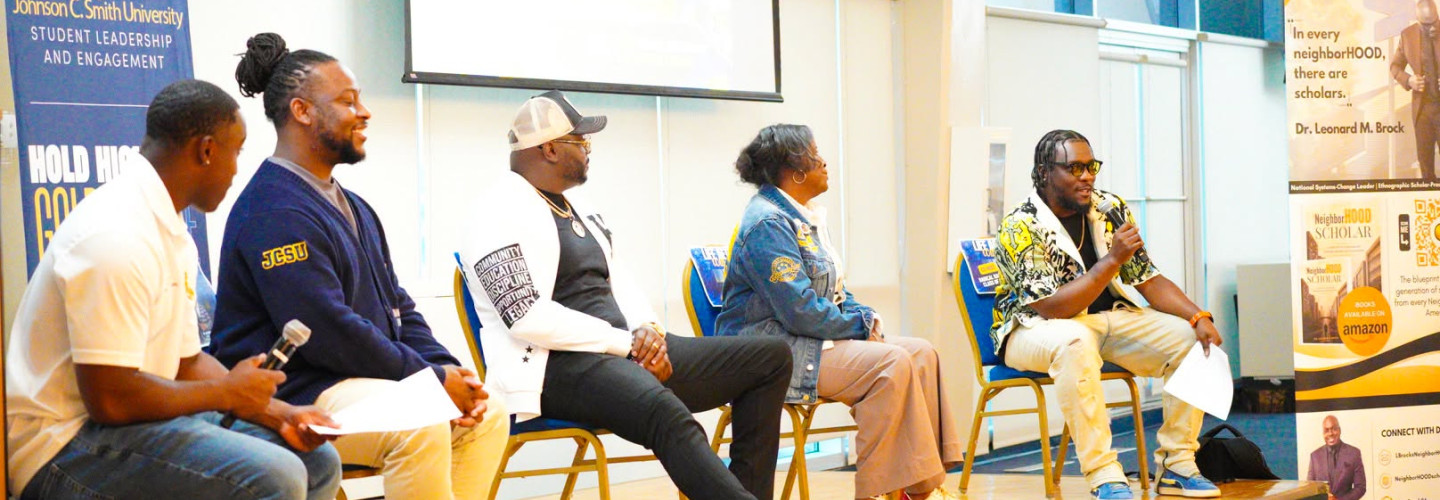
CHARLOTTE, N.C./October 1, 2026 - Mister JCSU Tyler Bowers hosted alongside alumnus Rashad Smith ’10 as co-host for a panel discussing Life After College: Navigating What Comes Next. Guest panelists Dr. Leonard Brock, National Systems Change leader, and Ms. Jontel Worrel ’07 and Mr. Anthony Brown ’07 spoke about their journey after graduation.
The conversations were filled with in-depth reflection from all panelists, inquiring into their backgrounds and stories up until now.
As a first-generation student, Bowers recognizes the imposter syndrome and lack of direction he experienced coming to campus, noting that having these guests will give an immersive perspective on life after college.
“Being able to have someone be a guest speaker that experienced college for the first time…I would say this event tonight it’s going to be a lot of guidance and a lot of eye openers for seniors, juniors, sophomores and even freshmen.” Bowers said. “They're gonna give you real, authentic, hard truth about what life after college is, and that's what our college students need to hear.”
Brock creates dialogue based on his book NeighborHOOD Scholars. Growing up in Rochester, New York, he shares lessons from his book through seven realities, hoping to guide soon-to-be graduates as they leave campus. As he has been living in Charlotte for the past six years, he sees coming to JCSU as a chance to connect with potential.

“I think it's about time for me to connect with the local community, and I look forward to paying it forward with the young people that attend the school here,” Dr. Brock said. “It’s an opportunity for me to showcase in real time how I was able to navigate the different terrains.”
Brock discussed the unique advantage people growing up in difficult backgrounds have and how the exposure it brings isn’t taught in academics. The author shares how it can “transfer skills to be positive.”
“I think for persons growing up in complex environments, being able to read rooms, they are able to develop a sense of discernment that you don't develop in school.” Dr. Brock said.
“I think the survival calibration is developed in complex environments and gives a person laser-like precision that other people miss,” he said. “Because they have a heightened level of sensitivity to things that may not necessarily appear blatant to others, but they are able to kind of sense it because of the discernment that they developed in their neighborhoods.”
Smith, also known as Radical Rashad, has a career in radio, media relations, and public relations. As a 2010 graduate, he shares how JCSU helped build his personal brand, including his peers and staff, teaching him vital skills he still uses to this day.
“I think this journey for me has been eye-opening. Like the things that I did on campus are things that I'm actually doing in my real life. I turned my campus experience into my career, and so I wouldn't have been able to do that if it had not been for Johnson C. Smith University and the people who helped shape who I am today” Smith said.“Being super involved as an undergraduate student between the years of 2006 and 2010 really shaped me to be a voice for my community, a voice for Black culture.”
“Many people remember me hosting coronations every year,” he said. “Because of that opportunity that she gave me to serve as the MC it shaped who I am today as a voice in my community.”
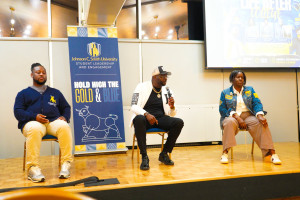
Even though the curriculum is important to retain, it’s also as important to be able to apply it elsewhere and put it into practice outside of class.
“The classroom certainly was helpful. The syllabus had its criteria on what I needed to do to pass the class, but it was how I put myself out there beyond the classroom that shaped who I am today.” Smith said. “What I learned in the dorm rooms, in the cafe, on the block, on the plots, just the yard in general, that's the foundation.”
Smith gives advice to students building their careers. He says the key to breaking into the industry is to take risks and not be afraid to be different.
“Not allowing people's perceptions and opinions to shape your journey in the media landscape is critically important. People are gonna talk about you anyway. Give them something good to talk about. Be yourself.”
Dr. Brock reassures that failures are inevitable in growth and not to let that hinder you from continually learning.
“I ask for students who are growing in their careers to be patient with the process, to allow themselves grace, but more importantly, don't be afraid to fail,” Dr. Brock said. “Failure is a part of the success process, and there's no way you get to success is not a linear path”
Dr. Brock said, “[The advice] I would give to students navigating their careers is to not to embrace failure as a limitation, but to embrace failure as an opportunity.”