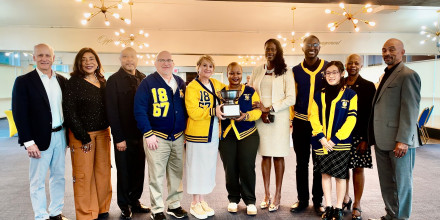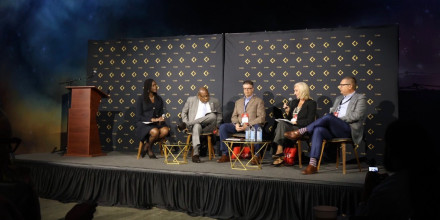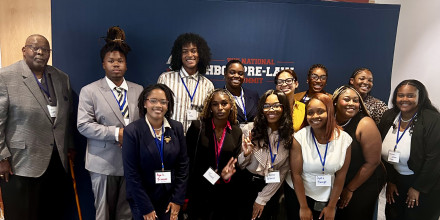
CHARLOTTE, N.C./February 5, 2026 — What does it mean to build wealth in a society where access has never been equal—and how do education, sacrifice, and community shape what is possible for the next generation?
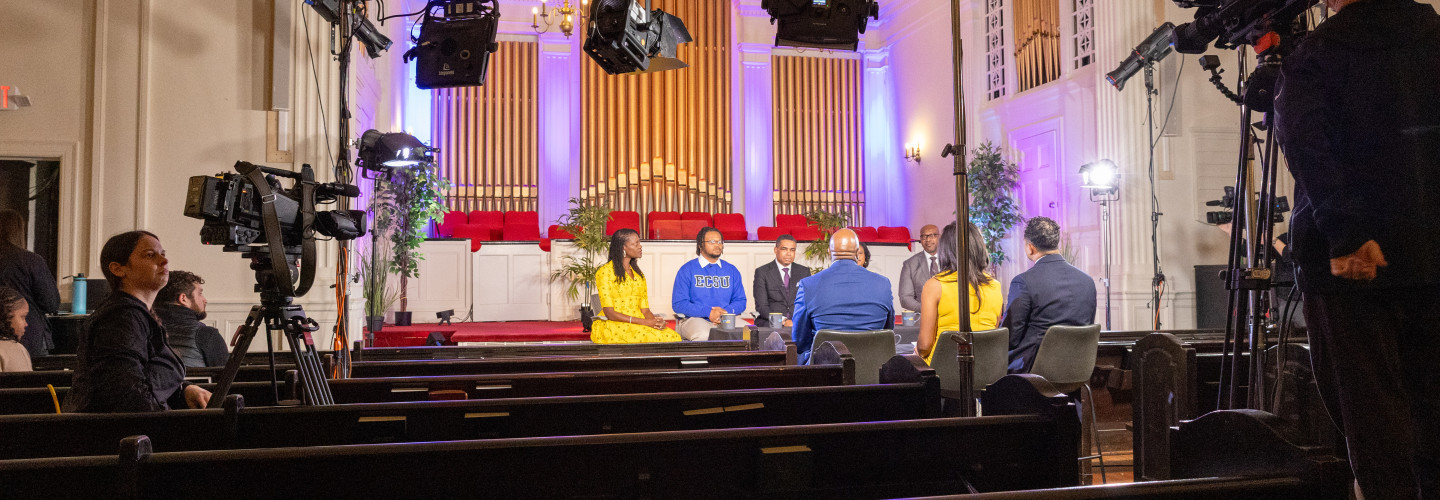
That question framed the Queen City News Black History Month Special: Black Wealth, filmed February 5, 2026, on the campus of Johnson C. Smith University inside the historic Jane M. Smith Memorial Church. The panel convened leaders in higher education, finance, professional sports, and civic engagement for a wide-ranging discussion on wealth creation, equity, and intergenerational responsibility.
Moderated by Queen City News hosts Julian Sadur, Alicia Barnes, and political analyst Khalif Rhodes, the conversation began with a foundational truth: wealth is inseparable from education—and from who has access to knowledge, choice, and protection. The panel featured JCSU’s 15th President, Dr. Valerie Kinloch, JCSU Trustee and President of Bank of America Charlotte, Kieth Cockrell, Chief Executive Officer of the The New North Carolina Project, Dr. Aimy Steele, Radio Analyst and former defensive end for the Carolina Panthers, Al Wallace, and Elizabeth City State University student, Brandon Gillespie.
This is the third year Queen City News has hosted a panel focusing on issues facing the Black Community from the JCSU campus during Black History Month. The first special in the series won a 2024 Edward R. Murrow Award for Excellence in Diversity, Equity and Inclusion. The Queen City News Black History Month special produced from JCSU in 2025 was nominated for an Emmy, and could win the coveted award.
Education as the First Safety Net
Dr. Kinloch opened the conversation by challenging the idea that success is purely the result of individual effort.
“Many people don’t have the framework to understand how equity, education, and success are connected,” Kinloch said. “And I don’t want to romanticize struggle.”
Kinloch emphasized that for many students—particularly first-generation college students—failure is not an abstract concept but a real risk without a safety net.
“We tell students to ‘fall forward,’” she said. “But how do you do that when no one has ever been there to catch you?”
At JCSU, more than 95 percent of students are Pell-eligible, Dr. Kinloch pointed out, and many are navigating higher education, financial systems, and professional pathways for the first time. The president stressed that higher education must serve not only as a place of learning, but as a protective structure.
“That is the power of higher education,” she said. “To create safe spaces for students who have never had access—to become the safety net.”
Public Education vs. Private Education
The panel also addressed the ongoing conversation around public versus private education. Dr. Kinloch pushed back on framing the issue as a binary.
“For many families, there is no choice,” she said. “People are struggling every day just to eat, to survive. They cannot simply decide what environment is best for their child.”
Dr. Kinloch reflected on her own journey as a product of public education, noting that she came to Johnson C. Smith University not because JCSU was defined as a private HBCU—but because its promise, its focus on community. It was the only school to which she applied. Students today don’t always understand the intricacies of the public vs. private dialogue. Students focus on culture and community.
“When I arrived here, I found a community that rooted for me,” she said. “That changed everything.”
Financial Literacy
During the discussion, Cockrell pivoted from the focus on public vs. private to a focus on financial education. He said for black communities, financial education can feel inaccessible in both language and delivery.
“So many people ask, ‘Where do I start?’” Cockrell said. “And that’s a real question.”
Cockrell explored the gap in financial education as it pertains to credit, in particular. Do students receive the financial education they deserve in formal educational settings.
“In the public education system we don’t teach credit,” he said. "So many of our college-educated youth are coming out of school with massive amounts of debt. Right? Much different than when I came out of school. And, so, they are already in debt.”
Cockrell went on to note that those in the financial sector like himself had an obligation to reach neighbors and friends to help them understand and apply the unspoken rules surrounding credit.
“In college we call this the ‘hidden curriculum,’” said Dr. Kinloch. “the hidden curriculum [are the teachings] hidden from students who are underrepresented or from underrepresented populations.”
Dr. Kinloch went on to explain that what students are taught in formal classrooms can be foundational but often the lessons don’t extend to deeper knowledge or a mastery of financial concepts.
Gesturing toward a solution, Cockrell emphasized the importance of short, digestible segments of financial education that might cover savings, loans, credit, investining. He reminded viewers that learning does not require perfection.
“It’s never too late,” he said. “And it’s never too early.”
Wealth and Property
NFL great Al Wallace noted that there is a knowledge gap for communities of color that prevents even those who are successful to pass on their wealth. Home ownership is a good example of that.
“So, I’m at that point in my life [when it comes to my] grandmother’s house that we grew up in; there was no protection around it. There was no trust so that when grandma passes, we are asking what happens to the that home and how that asset gets distributed to the rest of the family," said Wallace.
Cockrell also addressed the housing challenge familiar to many Black families. He advised that communication is everything.
“There are real conversations families have to have,” Cockrell said. “Do we sell Grandma’s house—or do we keep it, develop it, and maintain it? Choosing to keep it is about legacy—but it comes with sacrifice.”
Steele and Cockrell shared personal stories of sacrifice during the housing crisis. Steele says her family bought a house that felt like more than they could chew. The family cut corners to stay afloat. Cockrell says his family was on the brink of bankruptcy during the early days.
“We didn’t have financial education,” he said. “So we had to learn. I read books. My wife learned. We took classes. We surrounded ourselves with people who wanted to grow.”
That journey, he explained, required both financial and emotional sacrifice—but it laid the foundation for stability.
Building Wealth
Wallace reflected on the difference between earning money and building wealth. He says building wealth requires a mental shift.
“I made income before I understood wealth,” Wallace said. “No one taught me about credit or investing when I was young.”
After leaving the NFL, Wallace worked as an assistant principal, an experience that reshaped his understanding of leadership and service.
“Mentorship matters,” he said. “But apprenticeship is powerful. Showing young people how to save, invest, and make decisions—that’s real leadership.”
Student Voices
The conversation took on added urgency when Josiah Mathews, a 15-year-old prodigy at JCSU, posed a question via video: How can students get started with wealth creation?
Dr. Kinloch offered words of wisdom.
“When we talk about wealth, we have to talk about access, education, and protection,” she said. “Our responsibility—especially in higher education—is to become that net, to provide the knowledge, support, and community that allow students not just to survive, but to build and sustain opportunity.”
Dr. Kinloch and other panelists responded with a consistent message: start with education, then take action.
“It’s never too late to start,” Kinloch said. “And it’s never too early to give back. Even small steps—a dollar a month, a conversation, a habit—can grow into something transformational.”
Steele, a community advocate, urged families to normalize conversations about money and entrepreneurship.
“We’re afraid to talk about wealth and death,” Steele said. “But planning is an act of love.”
She emphasized that protection—through insurance, documentation, and honest conversations—is central to preserving wealth and dignity.
Dr. Kinloch added that sacrifice is often misunderstood because it is rarely visible or celebrated. Often, sacrifice is a hidden act of empowerment.
"Sacrifice isn’t always planned or obvious,” she said. “Sometimes it looks like sitting in your office late at night realizing that what you envisioned didn’t work out the way you hoped. But even in those moments, there is purpose.”
President Kinloch emphasized that sacrifice often involves giving up comfort, time, and certainty.
A Shared Call to Action
As the conversation closed, panelists returned to a unifying message: wealth is not just about money. It is about access and education, credit-building and community engagement, strategy and long-term investment.
The Queen City News Black History Month Special: Black Wealth will run February 20 and 23, 2026 on Fox 46.