Author of Black, Not Historically Black: Toward a Pan-Black College and University
Q: Tell us a little about yourself. What is the name of your book, and what did you talk about today?
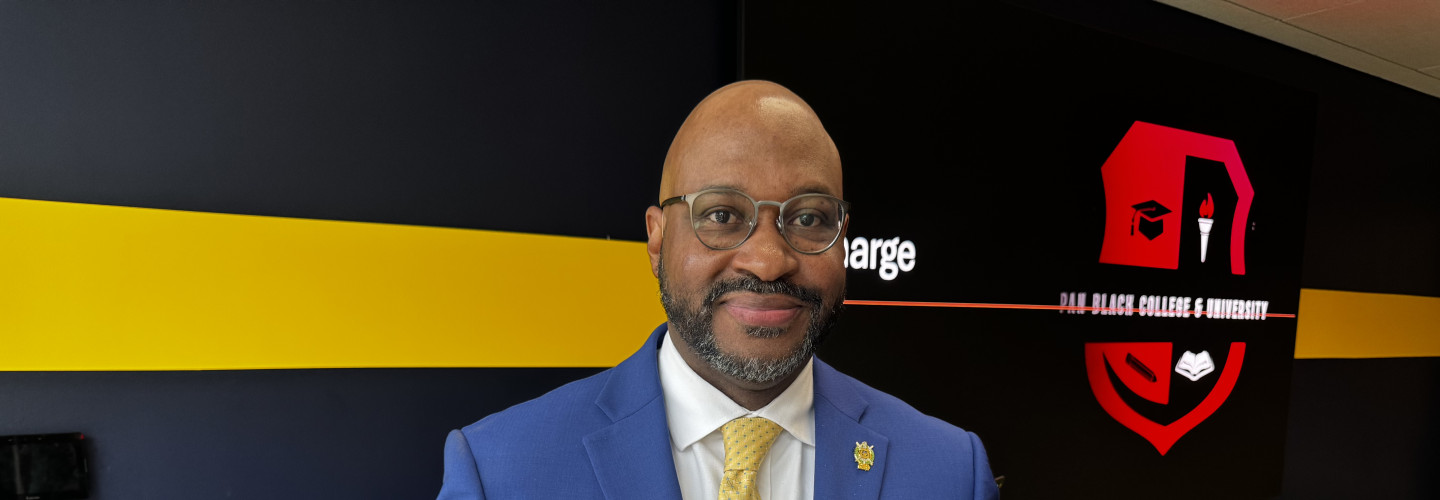
Dr. Joseph Jones: My name is Dr. Joseph Jones, and the title of my book is Black, Not Historically Black: Toward a Pan-Black College and University. What I discussed today was Black colleges—specifically how they can become better.
The book is both a critique and a prescriptive text. I examine leadership, education, organizational culture, respectability politics, and finances, and how all of these factors intersect and complicate the work of Black colleges. More importantly, I outline what we must do differently if we want our institutions not just to survive, but to truly thrive.
Q: When it comes to an institution like Johnson C. Smith University, how is your theory applicable?
Dr. Jones: What I really appreciate about Johnson C. Smith University is that I was here nearly 18 years ago as a professor, and even then, there was a deep commitment to cultivating young scholars. There was a clear expectation of excellence and a genuine investment in students’ intellectual development.
In my book, I have a chapter titled “Education, Not Miseducation.” When I taught here, I valued the fact that I could hold students to very high standards—and I was supported in doing so. I often tell the story of my department chair at the time, Dr. Deborah Quick. Students would sometimes complain about the rigor of my courses, but she stood firm and said, “If Dr. Jones says this is the standard for a senior thesis or this class, then that’s the standard.”
I never felt administrative pressure to change grades or lower expectations. At Smith, high standards were the expectation—and that ethos aligns directly with the arguments I make in the book.
Q: What impressed you most about our students?
Dr. Jones: Their questions were outstanding. I’ve given this lecture all over the United States, and the best conversations always happen with people who have actually read the book. I could immediately tell that the moderator had read it closely and truly wrestled with the ideas.
I was impressed by the level of engagement, the thoughtfulness, the critiques, and the original ideas being shared. That’s exactly what we want from students. We don’t expect you to accept everything we say at face value—we want you to push back, to interrogate ideas, and to challenge us.
Seeing Smith students engage me in that way—scholarly, critically, and confidently—was incredibly impressive.