Charlotte, N.C. / Jan. 27, 2026 - In the first Johnson C. Smith University Seminar of 2026, sponsored by the Office of the Provost, Dr. Sunil Gupta and Dr. Matthew DeForrest spoke before a large digital audience of faculty, staff, and students to demonstrate how scholarship across STEM and the humanities advances innovation, access, and student learning.
The powerful pairing of post-sabbatical presenters showcased the breadth and depth of faculty scholarship before an audience of more than 100. Topics ranged from cutting-edge biomedical technology to literary theory and Tolkien—affirming JCSU’s commitment to interdisciplinary excellence.
Dr. Sunil Gupta: Advancing Anatomy Through Digital Innovation
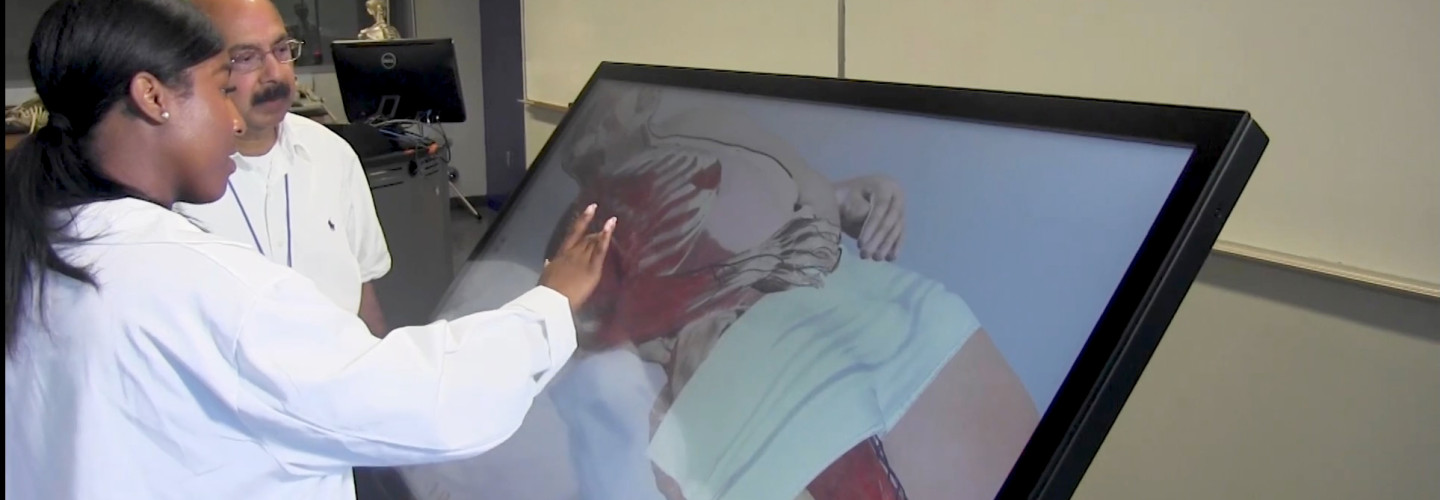
Dr. Sunil Gupta, an accomplished medical doctor and STEM Professor at JCSU, addressed how JCSU STEM is advancing anatomy studies through digital innovation. His presentation focused on the integration of the Anatomage Table, a state-of-the-art virtual anatomy and physiology platform currently housed in JCSU’s New Science Building and integrated into the health sciences curriculum.
The Anatomage Table, purchased through funds provided by the Mayor’s Racial Equity Initiative (MREI), allows students to explore full-scale, three-dimensional digital cadavers – the human body. Students, under Dr. Gupta’s instruction, can zoom in, rotate the human structure, examine individual organs, and engage in virtual dissections. As Dr. Gupta acknowledged, students can try out medical procedures without fear of error.
“This is cutting-edge technology that provides immersive and interactive anatomy learning,” Gupta explained. “Students can explore, dissect, reset, and repeat—learning without fear of making irreversible mistakes.”
Dr. Gupta emphasized that the technology is not intended to replace traditional dissection, but to enhance it.
“It’s most powerful when used alongside traditional methods,” he noted. “Traditional anatomy gives students the foundation; this adds dimension, depth, and accessibility.”
One of the platform’s most transformative advantages, Gupta explained, is its repeatability—allowing students to revisit dissection procedures multiple times with the goal of mastery. This ability to practice via infinite repetition is impossible with the dissection of real human cadavers. It is an issue of supply, in part.
The digital human body was constructed by slicing a real human body into one-millimeter sections. Each layer of the body is digitized into a three-dimensional form. As a result, students can now peel away layers of the anatomy, sharpening their surgical toolkit, gaining precision and new understanding. Dr. Gupta says the table is a complement totraditional training.
“It is most effective when used alongside traditional methods, not as a complete replacement. Traditional anatomy is still critical, but this allows us to extend learning far beyond what a physical lab alone can offer.”
Still, Gupta highlighted the table’s growing interdisciplinary reach, including the addition of five animal cadavers—monkey, dog, cat, mouse, and frog—opening pathways for zoology and comparative biology.
“That level of control and accuracy changes how students truly understand anatomy. They are no longer just memorizing parts. They are seeing how the body fits together in space,” Gupta shared.
Following Dr. Gupta’s presentation, Dr. Kinloch pointed out how the professors’ influence spans from the JCSU classroom to spaces beyond the gates. She emphasized how Dr. Gupta has become a liaison between JCSU, corporate spaces, and medical schools across the country, creating real opportunities for JCSU students post-graduation.
The audience expressed enthusiasm about the possibilities ahead for JCSU STEM. They noted how Dr. Gupta is standing at the cutting edge of invention and innovation.
Dr. Matthew DeForrest Takes on The Lord of the Rings
From the science of life to the science of literature: Dr. Matthew DeForrest, Johnson C. Smith University Professor of English, explored the inner world of narrative, emotion, and identity through his presentation, “The Two Loves of Master Samwise, or What I Did on My Sabbatical Vacation.”
DeForrest offered a fresh reading of J.R.R. Tolkien’s The Lord of the Rings, focusing on Samwise Gamgee—not only as Frodo’s loyal companion, but as a figure shaped by two defining loves: his devotion to Frodo and his enduring affection for Rosie Cotton.
“Sam’s story is not just about heroic friendship,” Dr. DeForrest explained, “but about the pull of home, love, and ordinary life that gives that heroism meaning.”
Framing his analysis in literary theory, Dr. DeForrest examined how Tolkien rejected the “willing suspension of disbelief” in favor of what he called sub-creation—a fully coherent world that does not require readers to force belief.
“If something pulls the reader out of that world,” DeForrest noted, “then the author hasn’t done their job.”
In his presentation, Dr. DeForrest also emphasized the importance of representation and modern interpretive lenses, including queer theory, while challenging scholars to ask whether interpretations preserve or distort the integrity of Tolkien’s carefully constructed world.
One of the most compelling aspects of DeForrest’s talk was his exploration of Tolkien’s fictional Red Book of Westmarch, through which the story is presented as a translated manuscript written by multiple narrators—Bilbo, Frodo, Sam, and later scribes.
Sam’s narrative voice, DeForrest argued, is marked by humility and restraint. “Sam minimizes his own importance even as others elevate it,” he recalled. As the only true commoner in the Fellowship, Sam occupies a radically different social position from kings and princes around him, yet earns universal respect through loyalty, duty, and moral clarity.
DeForrest concluded that The Lord of the Rings is, at heart, a family saga centered on Bag End—one completed by Sam himself with the quiet, powerful words: “Well, I’m back.”
During the Q&A session, Dr. Herring asked how literary criticism can remain usable and relevant in today’s world.
DeForrest responded by turning to literature’s capacity to cultivate compassion and emotional awareness. He emphasized that literature offers a powerful vehicle for helping people explore trauma, identity, and human connection.
He pointed to Tolkien himself, who suffered what would now be recognized as PTSD following World War I. DeForrest argued that Frodo’s post-war struggles mirror Tolkien’s own trauma, particularly in scenes where Frodo relives his wounds and darkness even after victory.
Such scenes, DeForrest explained, are now being used alongside works like The Odyssey and Beowulf in counseling and group settings, helping individuals process their own experiences through narrative.
He also noted how contemporary spaces—from book clubs to coffee shops—are increasingly becoming sites where people use literature to connect their own lives to shared stories.
In response to Dr. Karen Butler, Dr. DeForrest explained how he, as a white male professor [at an HBCU], is keenly aware that navigating such conversations – of race -can be complex. He begins with honesty, each reader beginning where they are.
“It’s better they respond viscerally than at a distance,” he suggested. “That’s a sign of long-term success.”
Together, these post-sabbatical presentations – by Dr. DeForrest and Dr. Gupta - embodied JCSU’s academic vision: integrating innovation with purpose, and pairing scientific advancement with humanistic inquiry.