CHARLOTTE, N.C./FEB. 29, 2024 - JCSU closed out Black History Month this year with a performance and discussion at a Lyceum event on leap day.
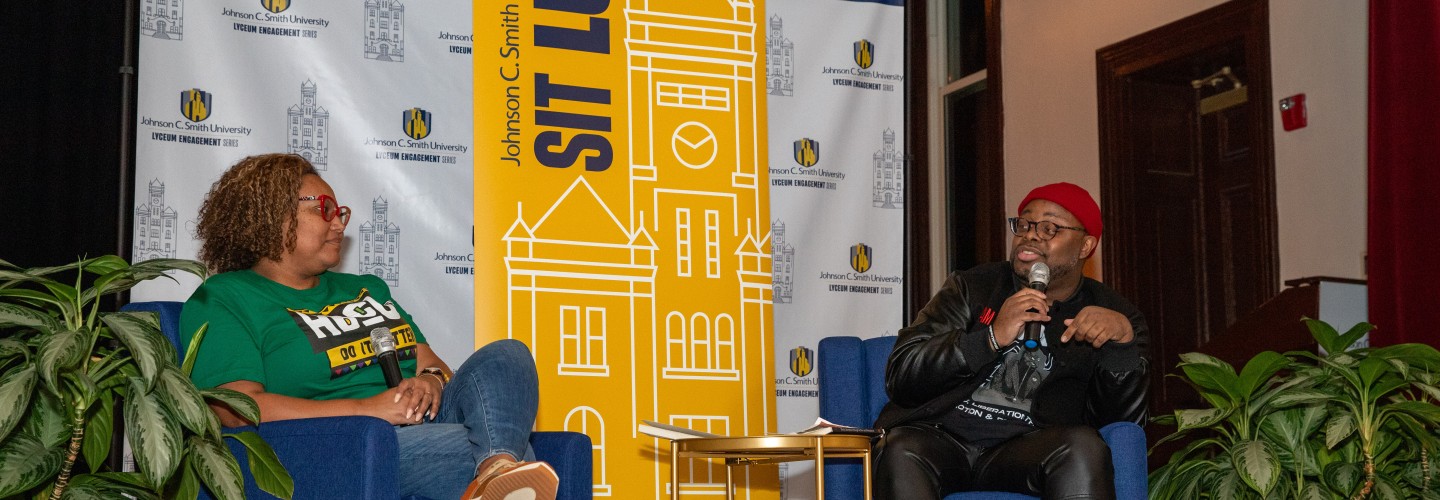
The event in Sara Gambrell Auditorium in Biddle Hall brought back several talented alumni who came to entertain and educate JCSU students.
The night started with music provided by DJ David Swaringen and was emceed by radio host Jessica Williams '04, known as Miss Jessica, "The Girl Next Door," on Power 98 FM.
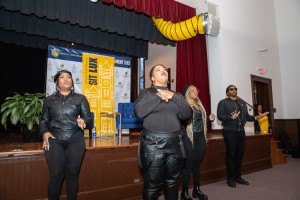
She introduced alumna Jessica Macks '03 and her band, who sang to open the show.
"That is the beauty that comes from Johnson C. Smith University," said Williams, joking that when she attended JCSU, they did not have DJs and singers at their Lyceum events.
After Macks' rousing performance, Williams introduced Dr. Terza Lima-Neves, chair of the Department of Social Sciences and Interdisciplinary Studies, who moderated a fireside chat with Dr. Frederick V. Engram, Jr. '05. He discussed his book Black Liberation Through Action and Resistance: MOVE.
Engram is an assistant professor of Higher Education at Fairleigh Dickinson University, whose work has appeared in Forbes, Diverse Issues in Higher Education, Blavity and a host of peer-reviewed journals. Engram has been featured on NBC, TMZ, People TV, Tavis Smiley and Roland Martin. He also gave a TEDx Dallas College Talk titled "Black Joy as an Act of Resistance" in 2021.
His book is a call to action for Black millennials, as well as (white) "co-conspirators," interested in working toward anti-racism in their own lives or who are working in the space of Black liberation, pointing out that the difference between a co-conspirator and an ally is that an ally still can pick and choose who deserves assistance and help. In contrast, a co-conspirator is willing to give up something in the struggle.
"To protect people who are more marginalized than themselves," he explained, "it requires you to go further. It requires you not to be comfortable. It requires you to lose things."
After touching on the performative nature of much of what was seen recently in the past few years from social justice movements, Engram spoke about the Black church and its complicated relationship with marginalized people, acting as both a place of safety and a place where oppression happens.
He spoke about his upbringing and the ways that his family life reinforced ideas of anti-Blackness that he has had to unlearn in his personal journey.
"I learned how my Blackness was beautiful. My siblings' Blackness was beautiful because we came from her," Engram said about what he learned from his mother. "I (also) learned how somebody else's Blackness is less beautiful, and I learned colorism. Right through that, I learned that Blackness looks better in a certain kind of way."
Engram also shared the inadequacies he felt when he first came to an HBCU.
"I didn't feel Black before I got here. I didn't feel Black enough to be here."
He shared that he initially struggled and questioned his decision to come to JCSU, explaining, "This might be 'top level' Black, and I don't know if I have it in me to be here."
Engram attributed the friendships and the people he met while studying at JCSU to helping him accept who he was and helping him in his journey. He explained how motivating it was to see JCSU's first Black woman president, Dr. Dorothy Cowser Yancy ’64, model how to work in academia and that he was inspired by the many Black leaders, Black women leaders in particular, whom he met at JCSU. Lima-Neves then asked him if he was a Black feminist, and he replied that he was.
"You go really hard for Black women, those who identify as Black women, and you don't play about us in the book. And so, I just wanted to say, 'thank you,'" said Lima-Neves. "You are definitely not an ally (of Black feminism); you are a co-conspirator."
Engram rounded out the night by answering questions from the audience and reading excerpts from his book.