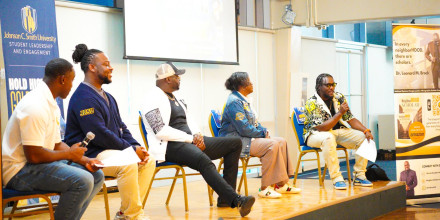
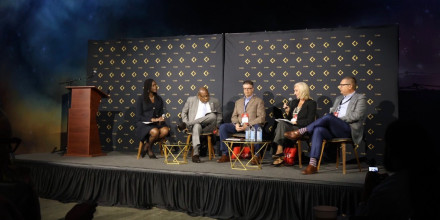
JCSU-led research team delivers a featured workshop at the national economic development summit in New Orleans, presenting findings on expanding HBCU participation in the clean energy innovation economy.
CHARLOTTE, N.C./JULY 15, 2026 — Johnson C. Smith University continues to strengthen its national reputation for research, leadership, and community engagement through the work of Dr. Bryan Q. Patterson, Assistant Professor of Management and Academic Advisor in the Department of Business Administration. Over the past two years, Dr. Patterson has led nationally recognized research examining how Historically Black Colleges and Universities (HBCUs) can expand their role in clean energy innovation, workforce development, and equitable economic growth.
Most recently, Dr. Patterson and his research team delivered a featured 90-minute workshop, “Exploring Energy Research and Its Impact on Policies and Infrastructure in Small-Medium-Sized Cities,” at the 2026 Cityscapes Summit, held May 18–20 in New Orleans. Hosted by the New Growth Innovation Network (NGIN) with headline sponsorship from the Robert Wood Johnson Foundation, the biennial summit convened hundreds of economic development, philanthropic, government, and community leaders from small and mid-sized cities across the country.
The interactive workshop presented key findings from the team’s multi-year study of barriers facing Black and minority advanced-energy researchers at HBCUs and other higher education institutions, and engaged attendees in facilitated roundtable discussions on research pipeline development, mentoring and network models, and strategies for researcher–community partnership. Dr. Patterson presented alongside research collaborators Henry Golatt and Karen Soares (HBCU Community Development Action Coalition), Dr. Yasuyuki “Yas” Motoyama and Mel Delpech (The Ohio State University), and Dr. J. Chris Ford (Florida International University). The team’s workshop slides and full research report, Advancing Equity in Energy Research, are published in the summit’s official resource library.
At the center of this work is a nearly $500,000 Alfred P. Sloan Foundation research grant (G-2021-16978), awarded to Johnson C. Smith University with Dr. Patterson serving as Principal Investigator. The project investigates the systemic barriers that researchers at HBCUs and other Minority Serving Institutions face in accessing clean energy research funding, incentives, and commercialization opportunities. The study examines clean energy innovation ecosystems across four Southeastern regions — Charlotte-Greensboro, Raleigh-Durham, Atlanta, and Miami — and brings together collaborators from Florida International University, The Ohio State University, the HBCU Community Development Action Coalition (HBCU CDAC). The research has produced peer-reviewed scholarship, including a 2025 article in Energy Research & Social Science, a multi-institutional white paper, national stakeholder roundtables, and policy-relevant recommendations designed to expand participation in federal and state clean energy research programs and strengthen regional innovation capacity.
This scholarship addresses one of the most important questions facing higher education and regional economic development today: How can HBCUs serve as anchor institutions that drive innovation, workforce development, and community prosperity? That question ran throughout the Cityscapes Summit, where sessions on community wealth building, anchor institutions, and inclusive innovation ecosystems repeatedly highlighted universities — and particularly HBCUs — as essential partners in building more inclusive regional economies.
Dr. Patterson has also expanded the reach of this research through public scholarship and national media. He was recently featured on the Green Streets Forum in the episode “Why HBCUs Are Essential to America’s Clean Energy Future,” where he discussed how HBCUs are preparing future leaders while contributing to research, sustainability, and economic opportunity through collaborative partnerships among universities, government agencies, industry, and communities.
“As institutions deeply connected to their communities, HBCUs possess tremendous capacity to develop talent, strengthen regional partnerships, and contribute meaningful solutions to our nation’s most pressing economic and environmental challenges,” said Dr. Patterson. “Through collaboration, research, and innovation, we can build stronger ecosystems that create opportunity for everyone.”
Dr. Patterson’s scholarship reflects Johnson C. Smith University’s mission of advancing education that serves both students and society. His work integrates organizational leadership, community engagement, workforce development, and innovation to address real-world challenges while expanding opportunities for historically underrepresented institutions and communities. It also complements the University’s broader momentum in innovation and community partnership, including the April 2026 Community Tech Day, which brought students, city leaders, and technology partners together to develop smart-city solutions.