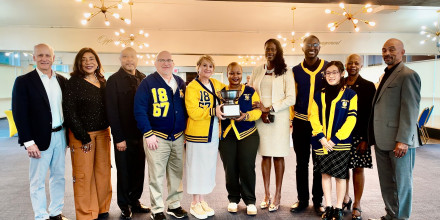
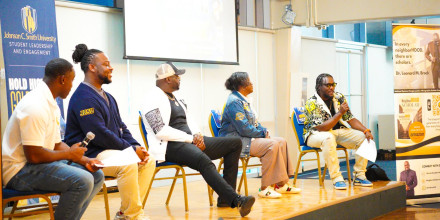
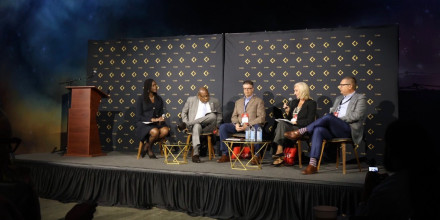
CHARLOTTE, NC / May 26, 2026 - Three influential South Carolina-born leaders came together in Charlotte for an unforgettable evening centered on political history, democracy, and the enduring lessons of Reconstruction.
Congressman Jim Clyburn’s Fireside Chat and Book Signing, organized by the D. Wilson Agency and hosted at First Baptist Church-West, featured discussion of Clyburn’s new book, The First Eight. The evening brought together Congressman Clyburn, Charlotte icon and former Mayor Harvey Gantt, and Johnson C. Smith University President Valerie Kinloch, Ph.D., for a conversation that explored the past while challenging attendees to think critically about the future.
Before the discussion began, President Kinloch delivered a heartfelt introduction, reflecting on her own South Carolina roots and the profound impact of both Clyburn and Gantt.
“As a young girl growing up in Charleston, South Carolina, I would always hear the names James E. Clyburn and Harvey B. Gantt,” Kinloch said. “In many ways, I feel like I grew up with Clyburn and Gantt as really close relatives. Although I did not know them in Charleston and did not cross paths with them in South Carolina, I only met them after I moved here to Johnson C. Smith University in 2023.”
President Kinloch praised both men for their bravery and never-ending commitment to community; their influence seemed boundless.
“Their lives, their legacies… their investments in our community speak volumes and speak to the power of critical leadership,” she said.
President Kinloch concluded by celebrating the leaders’ common core: a rich South Carolina history and heritage.
“I am proud to not just be an alumna of Johnson C. Smith University and the 15th President of Johnson C. Smith University, but I am honored to be a native of South Carolina—of Charleston,” Kinloch said. “I like to say Charleston, South Carolina creates great people, and two of those people are here today.”
Those two people - Congressman James Clyburn and Hon. Harvey Gantt – revealed the variegated textures of South Carolina dirt, where heroes emerged from the pebbles. Clyburn, for his part, pulled out the hidden historical roots: history of Black congressional leadership in the United States, with a special focus on Robert Smalls and George Washington Murray. Using their stories as an emblem, Clyburn presented the consequential impact of Jim Crow on black political authority in the United States.
In specific terms, Clyburn described how progress was halted when Jim Crow became “the law of the land,” underscoring the cyclical nature of American history and the need for continued civic engagement and education.
Serving as moderator, Gantt brought both historical insight and personal perspective to the discussion. Recalling their shared South Carolina upbringing, he joked about the different paths the two traveled before becoming national figures.
“We kind of grew up together in South Carolina,” Gantt said. “He was in a small town and I was coming from the big city of Charleston. He was doing wonderful things at South Carolina State College, making a name for himself in politics, and I was running around talking about becoming an architect.”
Despite their shared experience, Gantt said Clyburn’s book pried open the wounds of history.
“The book touched me in many ways because the book taught me some things about Charleston that I didn’t even know, and I thought I knew everything,” Gantt said, drawing laughter from the audience.
One question that intrigued Gantt was how Black political representation emerged so quickly following the Civil War. He wondered why it disappeared for nearly a century. Gantt highlighted the fallow period in Black South Carolina politics, 1897 to 1992. Not a single black man or woman was elected to Congress from South Carolina in that near 100-year window, until Clyburn was first elected in 1992.
In his book, The First Eight, Clyburn chronicles the journeys of those great eight men in the late 1800s who paved the way.
“They were different people,” Clyburn said. “Only three of the eight had ever been enslaved. Those three got their freedom in different ways.”
Clyburn explained how Joseph Rainey’s father, in a bold and audacious act, purchased freedom for the family. Robert Smalls seized a Confederate ship and delivered it to Union forces.
“Robert Smalls was the only genuine hero of the Civil War,” Clyburn said. “Robert Smalls was the most consequential South Carolinian who ever lived.” Clyburn noted that Smalls was born into slavery, suffered and transcended. He became one of the most influential political leaders of the era.
Clyburn told the story of George Washington Murray of Sumter, South Carolina, who was born into slavery, was emancipated, and later served in Congress. In an interesting twist, the author became the subject. Clyburn revealed that he may be a blood descendant of George Washington Murray. Two men, one bloodline, common trajectory: from SC to DC. Still, the pauper to power story of Murray and Smalls is a unique one to tell.
“The other five [Black congressmen elected during Reconstruction] were highly educated African Americans,” Clyburn concluded. They were of the Black upper crust, living lives of relative privilege. In his book, Clyburn illustrated the broad educational and socio-economic backgrounds of the first eight Black men to serve in the United States Congress. The carefully crafted narrative was a window into another world and a mirror to our own. Power is ephemeral. History is cyclical.
The room sat forward in the church pews as the conversation hit a climax and denouement: the wounds of history now raw and open for healing.