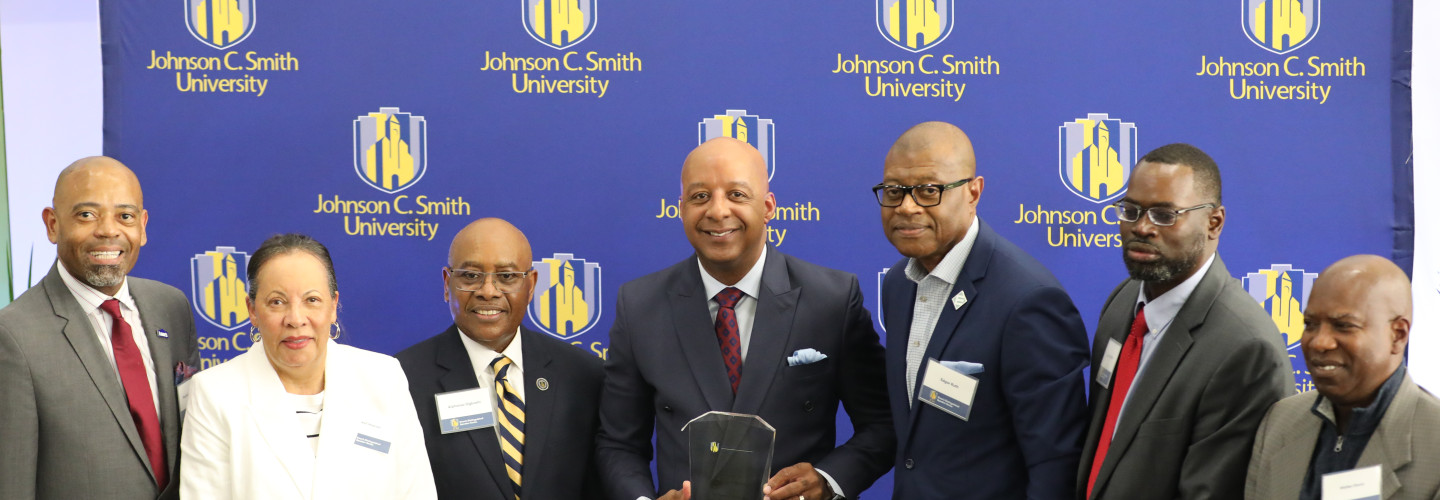
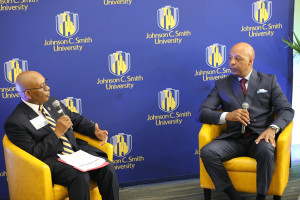
Marvin Ellison, Chairman and CEO of Lowe’s, and Dean Alphonso Ogbuehi during the event.
CHARLOTTE, N.C. / APRIL 13, 2026 - The Johnson C. Smith University College of Business and Professional Studies welcomed one of the nation’s most influential corporate leaders, Marvin Ellison, Chairman and CEO of Lowe’s, a Fortune 100 company based in Mooresville, North Carolina. Ellison headlined the Dean’s Distinguished Speaker Series on April 13, 2026 inside the New Science Center’s Truist Auditorium, an event hosted by Dean Alphonso Ogbuehi and the College of Business and Professional Studies. It was moderated by Dr. Judith Crocker-Billingsley, Associate Professor of Social Work.
Ellison joined a packed house of students, faculty, and community leaders for a fireside chat titled Visionary Leadership at Scale: Excellence, Ethics, and Impact in a Fortune 500. The presenting sponsor of the event was Diversified Maintenance. Ellison offered a candid look at the mindset and values required to lead at the highest level in corporate America. The event offered an inside look at the leadership philosophy guiding one of the nation’s largest retailers and most respected leaders.
As CEO of Lowe’s, Ellison leads more than 1,700 stores and approximately 300,000 associates nationwide. His leadership emphasizes operational excellence, customer experience, and long-term growth—principles he linked to personal discipline and resilience.
Provost and Chief Academic Officer Dr. Patrick Martin, speaking on behalf of JCSU President Valerie Kinloch, highlighted Lowe’s $8 million investment in JCSU, noting that the partnership is “investing in the dreams and potential in every single student at Johnson C. Smith University.” The Lowe’s gift targets retention and bolsters faculty recruitment and professional development.
Dean Ogbuehi led the conversation, opening with a reflection on Ellison’s journey. “These journeys are not always linear,” he said. Ellison reinforced that message with a reflection on his personal path. “What it doesn’t show is the 14 times I got passed up for promotions,” Ellison revealed. “You’ve got to be resilient.”
Drawing from his humble upbringing in rural Brownsville, Tennessee, Ellison emphasized the power of perseverance and purpose. “You can’t let your beginnings depict your future,” he said. “Operate with integrity. Be authentic. Put God first in everything you do.” When Dean Obguehi inquired about Ellison’s role and responsibilities as a Black CEO, Ellison acknowledged his unique positionality while highlighting the bottom line.
“We reward companies for the outcomes they produce. For me, as a Black man that has been discriminated against, who has been passed over 14 times, I don’t need a guideline on how to create positive outcomes on diversity. We have the most diverse executive leadership team in the Fortune 500” – and one of the most successful. Ellison has appeared on Barron’s annual list of “Top CEOs” and Fortune’s “Most Inspirational CEOs.” His words of wisdom for students: “This is about making sure you have the skills necessary to drive positive outcomes.”
The Lowe’s Chairman and CEO also encouraged students to seek growth through challenge. “If you want to get ahead in business, you have to take the jobs nobody else wants,” Ellison said. That is the journey of the climb; you must absorb the lessons along the way. Workplace culture has lessons boiled in, but leaders bear responsibility when it comes to cultivating an inclusive experience.
“You create culture by making sure people feel like they are a part of something,” he said. Dean Ogbuehi summed it up this way: “It’s not the symbolism but concrete actions that makes culture stick.”
Turning to the shifting culture of work in the era of Artificial Intelligence, Ellison challenged students to prepare for rapid technological shifts. “As AI continues to be utilized, you can’t take that time as a time to chill,” he said. “You have to use that time to be more productive.” Ellison emphasized that human-centered skills will remain essential. “Communication skills will become a superpower,” he said. “Know how to communicate, how to persuade, how to influence.”
The conversation resonated strongly with students, who engaged Ellison with thoughtful questions about risk, confidence, and career growth.
Student leader, Omar Rondon-Sanchez, a business finance major, took the opportunity to ask Ellison about a defining early career risk, prompting Ellison to reflect on a bold early-career pivot. At the time, Ellison was on the rise and full of potential when he was passed over for a promotion. With a penchant for risk and a turn toward self-investment, Ellison made the decision to take a job in Minneapolis, moving his family to the Midwest. It was the dead of winter. His wife was three months pregnant. “God laughs at our plans,” Ellison said, describing the leap of faith that carved open his future.
Jhaid Westbrook, a senior business major and Student Government Association public relations chair, asked how students can overcome self-doubt. Ellison responded with a lesson in authenticity: “Why not try to be yourself? When self-doubt creeps in, understand that God doesn’t make mistakes.”
Caleb Carr, a business finance major and founder of JCSU Capital Management, asked about the importance of mentorship. Ellison encouraged students to be proactive in shaping their own paths. “Make sure you set a standard for yourself. Reach out to someone and ask them for advice,” he said. He reminded students that mentorship can come through direct interaction with seasoned professionals and through observation: learn lessons from public leaders from afar.
Autumn DeShields asked what young leaders often misunderstand about success. Ellison focused on adaptability and the key to lifelong learning. “The greatest mistake we make is thinking that when we get the degree, learning is over,” he said. “When people are no longer willing to learn, it sends a signal—they are no longer willing to grow.”
Ellison’s career reflects both historic achievement and transformative leadership. Prior to Lowe’s, he served as Chairman and CEO of JCPenney, becoming the first African American executive to lead two Fortune 500 companies. He is an accomplished man with a wise role model. His father, a life-long farmer, is the smartest man he knows.
The Dean’s Distinguished Speaker Series continues to connect JCSU students with industry leaders whose experiences bridge theory and practice, life and learning. At the end of the day, Ellison’s brand of visionary leadership seems rooted in a recipe of focus and flexibility, sacrifice and strategic decision-making, faith and fortitude.