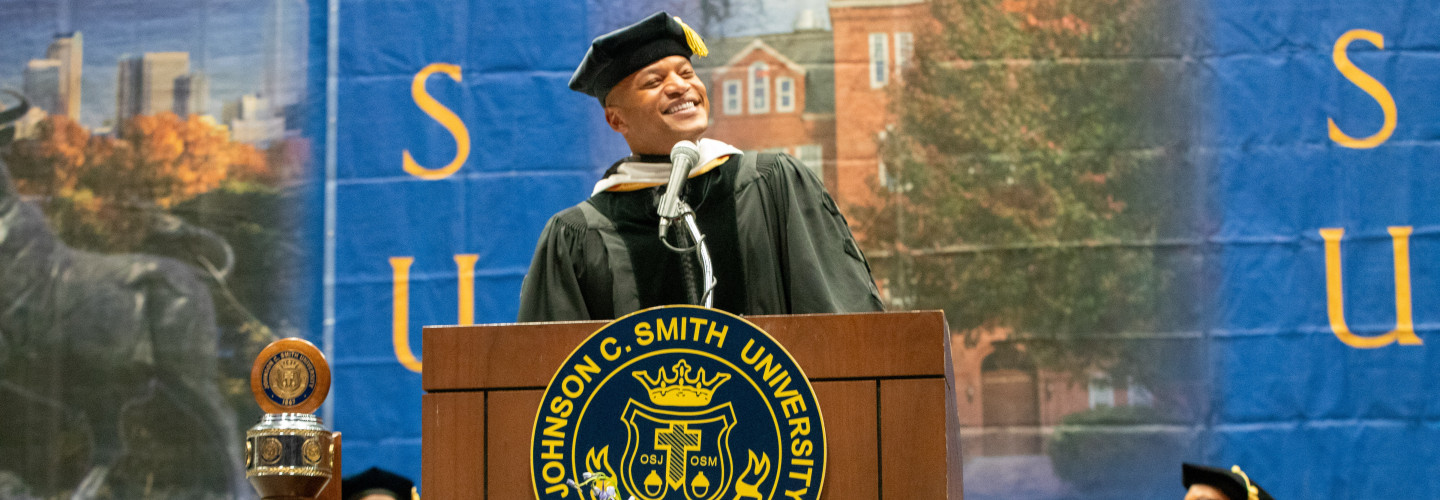
Governor Moore addresses students at the 153rd Commencement
CHARLOTTE, NC / May 17, 2026 - Maryland Governor Wes Moore delivered a powerful commencement address to the Johnson C. Smith University Class of 2026 on Sunday, May 17, 2026. He urged graduates to embrace leadership during this defining moment in American history. It was a message of congratulations, commendation and a call to action.
Governor Moore spoke before a bubbling display of soon-to-be graduates from the College of STEM, College of Liberal Arts, and College of Business and Professional Studies, their exuberant families, esteemed faculty, staff, and alumni at JCSU’s 153rd Commencement Ceremony. He praised President Valerie Kinloch and the University’s enduring mission of producing leaders committed to justice and community transformation.
“Madam President, you are absolutely outstanding,” Moore said. “Can we please give it up for our President and the amazing work that she does and continues to do? Sincerely, your reputation, not only in North Carolina but all around the country, is spectacular.”
Moore, the 63 rd Governor of Maryland and the first black governor to hold the office, applauded the resilience of the graduating class. He acknowledged that many in the class had overcome obstacles - personal, financial and social - to arrive at this pivotal moment in their lives.
“Despite the fact that for many of you there was no roadmap for you, you persevered and you made it,” Moore conveyed.
Throughout the address, Moore returned to the mission of Johnson C. Smith University – to lead in service – and one central challenge for the Class of 2026: whom will you fight for and defend.
“The most important question you’re going to be asked is not what did you study here,” Moore said. “The most important question you’re going to be asked is who did you choose to fight for? Who mattered? Who did you choose to fight for when it wasn’t easy?”
Moore connected that challenge directly to the university’s historic roots, reminding graduates that Johnson C. Smith University itself was founded during one of the nation’s most turbulent eras, on the heels of American slavery. JCSU was built by the formerly enslaved during Reconstruction, gaining guidance from a determined trio of Presbyterian ministers: Rev. Samuel C. Alexander ,Rev. Willis L. Miller, and Rev. Sidney S. Murkland.
“I know Johnson C. Smith was built for a moment like this because Johnson C. Smith was built in a moment like this,” he said with poetic inflection. “We are just watching history repeat itself.”
Moore recounted how Presbyterian ministers founded the institution in 1867 during Reconstruction using lumber from a former Confederate Navy yard. This history of sublimation is important to memorize and repeat. JCSU’s ancestors transported the raw materials of the confederacy to the hilltop and turned the leftover lumber into the light of learning.
“This place was built with wood that was used to wage war,” he said. “This place was built with wood that was used to enslave our ancestors — wood that would eventually become buildings of education for our ancestors.”
“The founders of this institution knew who they were fighting for,” Moore continued. “That’s why they never stopped fighting. They fought for the hope of you. They fought for the hope of today.”
Calling graduates “citizen scholars,” Moore warned of growing threats to democracy, threats to their civil rights. Voice soaring with care and conviction, the governor urged students to fight for what is right, to push through the difficult spaces.
“You are now threatened to have fewer voting rights than your parents,” he said. “It is not lost on me at all that I am the first Black governor of Maryland, the only Black governor in this country,” Moore added. “We are watching political redlining happening in real time. It is happening in this country. It is happening right here in North Carolina.”
Moore told graduates they are entering a world filled with division, inequity and failed leadership, but said their voices and values are needed now.
“You are walking into leadership spaces where we have people with very big titles who are doing absolutely nothing,” Moore said. “You are walking into a society where people are intentionally using their power to hurt other people who don’t have the same amount of power.”
The audience of students listened attentively to the galvanizing address.
“We need you in these spaces,” Moore continued. “We need you in these rooms. We need you to lead with values, with love, unapologetic and unafraid.”
Moore challenged graduates to create systems rooted in equity. He implored students to lead with knowledge, out of understanding and empathy.
“We need you to build better systems. We need you to leave no one behind,” he said. “If you do these things, you will not just represent this school with distinction, you will also lift up others as you climb.”
For Governor Moore, the past is the present, yet modern students have the benefit of history, a relentless lesson book. Moore encouraged students to remember the mission.
“That has always been the mission of this institution — to lend a hand to a child in poverty,” he said. As a powerful emblem, that child was a young Wes Moore, once poor and searching.
“To the young man who felt handcuffs on his wrists at 11 years old, whose mother did not get her first job that gave her benefits until he was 14, but who now stands before you as the 63rd governor of the State of Maryland — if you don’t fight for our folks, who will?”
The speech was a call to action rooted in a question. “Who are you going to fight for?” he inquired. “Who will matter? Who are you willing to stand on the wall for?”
Moore charged graduates to carry JCSU’s mission into the world.
“The people who carved ‘Sit Lux’ [Let there be light] into the cornerstone in Biddle Hall in 1884 did not put those two words there as a wish,” he said. “They put those words there as an instruction and as the assignment.”
The JCSU soon-to-be graduates sat before the stage in their final act, adorned in decorated caps and long black gowns, ready to get to work.