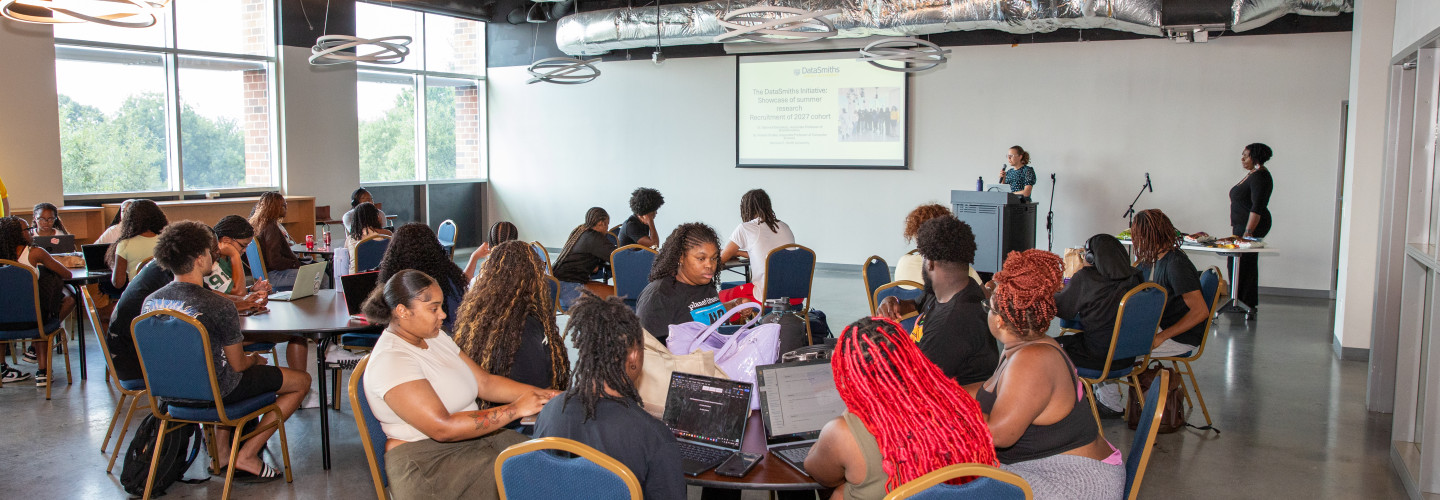
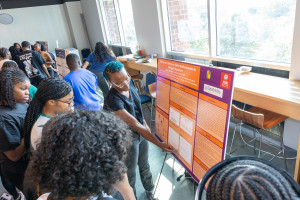
CHARLOTTE, N.C. / Sept. 2, 2026 - Johnson C. Smith University students transformed data into discovery during the inaugural DataSmiths Research Showcase. Students presented research projects that examine student well-being, tick genetics, sound frequencies and human health.
The showcase, held Thursday, Sept. 3, 2026, in JCSU’s New Science Center, marked the culmination of the 2025–2026 DataSmiths cohort. The National Science Foundation-funded initiative prepares STEM students for graduate education and careers in data-intensive fields such as data science and bioinformatics.
Dr. Sabine Otienoburu, associate professor of Bioinformatics and leader of the DataSmiths initiative, said students were immersed in data throughout the program.
“They have been infused with data from the very beginning of the year,” Otienoburu said. “They learned different programming languages, ways to analyze data and ways to visualize data. After the boot camp, they were sent to different institutions to conduct summer research projects.”
During the academic year, students participated in seminars featuring professionals working in bioinformatics, public health and technology. They also received mentoring and completed an intensive boot camp that introduced them to programming, data analysis and data visualization. Students explored how artificial intelligence can be used in drug design.
The cohort then completed a four-week summer research experience at JCSU, UNC Charlotte or Winston-Salem State University. The September showcase gave students an opportunity to present their findings, explain their methodologies and demonstrate their development as emerging researchers. Several students will also travel to present their research beyond JCSU.
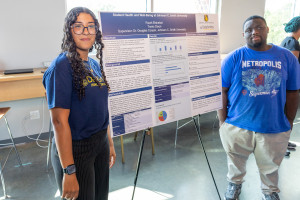
Farah Elshahat and Travis Dixon presented “Student Health and Well-Being at Johnson C. Smith University,” a project that sought to identify factors that affect student mental health, well-being and persistence.
The team reviewed whether the available data adequately represented JCSU’s student population and examined characteristics including age, race, gender, classification and first-generation status. They also considered psychological distress, financial pressures, food insecurity and feelings of belonging.
“We started collecting data, and then we developed recommendations for the school,” Elshahat said.
Their recommendations included strengthening financial assistance, increasing awareness of the University’s food pantry, improving the quality of cafeteria food and creating additional opportunities for students to feel connected to the JCSU community.
“Some students do not feel that they belong in the school, and that can be one reason they leave,” Elshahat said. “We want to provide the school with data that can help improve the student experience.”
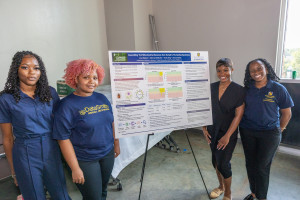
At UNC Charlotte, Zoe Migioni, Katoria McMullen, Kaila King and Isheca Bailey worked with researchers on “Assembling Tick Mitochondrial Genomes from Somali & the Gambia Specimens.”
The students analyzed DNA-sequencing data to help characterize and identify tick specimens. Using bioinformatics tools including FastQC, GetOrganelle and NOVOPlasty, the team evaluated the quality of the data and attempted to assemble the ticks’ mitochondrial genomes.
Although the sequencing data were high quality, the team did not have enough DNA fragments, known as reads, to reconstruct a complete mitochondrial genome. The students assembled approximately one-tenth of the expected length and concluded that additional sequencing data would be needed.
“Even though we had really good data, it still wasn’t enough,” Migioni explained.
The outcome provided an important lesson about the scientific process: Research does not always produce the anticipated result, but the findings can point to important next steps.
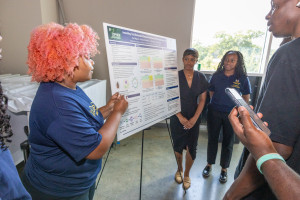
Migioni credited the UNC Charlotte researchers with helping the students understand both the process and the significance of the work.
“I never thought I would be working with ticks,” she said. “The researchers were very passionate about the project and intentional about explaining the process.”
Students who conducted research at Winston-Salem State University worked under the guidance of Dr. Tennille Presley to examine possible relationships between sound frequencies and physiological responses.
Information Systems major Sydney Bledsoe helped develop a provisional, rule-based system in Python that uses blood-pressure stages to suggest a Solfeggio sound frequency for further study. The research involved 19 participants at a veterans home who listened to music containing standardized frequencies while researchers collected blood-pressure and EKG data.
Bledsoe said the study’s preliminary results suggested that 528 hertz produced the most promising response among the frequencies tested. She emphasized that the prototype is not a diagnostic tool and that more research is necessary.
For Bledsoe, the experience also demonstrated how her technology background could contribute to scientific inquiry.
“As an information systems major, I initially felt like I didn’t have much footing in the program because I don’t study science,” Bledsoe said. “Dr. Presley helped me understand the different roles I can have in science as a technologist.”
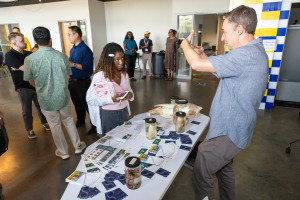
Bledsoe entered DataSmiths without previous research experience. By the conclusion of the program, she had learned to work with programming languages, analyze and visualize health data, conduct research and create a scientific poster.
“There are not a lot of students who get the opportunity to learn how to analyze data, create a research poster and conduct their own research,” she said.
Her sister, Skylar Bledsoe, presented “Differences in Veteran vs. Civilian Bodily Response to Solfeggio Frequencies.” She used a galvanic skin-response sensor to measure changes in participants’ skin conductance—a physiological response that can reflect changes in arousal—as they listened to different frequencies.
Skylar Bledsoe’s preliminary analysis found that civilian participants demonstrated a higher average galvanic skin response than the veterans in the study. She cautioned that the data did not establish the cause of the difference and that other variables could have influenced the findings.
“There could be other factors influencing why civilians had a higher average response than veterans,” she said.
She described her experience at Winston-Salem State as “fantastic” and credited Presley with helping the students become comfortable with laboratory procedures, data collection and analysis.
“She eased us into working in the lab, gathering data, analyzing it and understanding what we needed to do,” Bledsoe said.
DataSmiths is supported by a $399,000 NSF grant that will fund two cohorts. Each cohort concludes with a research showcase through which students gain experience presenting and defending their work before an audience.
“We were very excited to receive this grant,” Otienoburu said. “We are very happy that we will have two cohorts of DataSmiths.”
JCSU is now recruiting STEM majors for the second DataSmiths cohort, which will begin in January 2027. The program is open to sophomores and juniors with a minimum 3.0 GPA who are interested in pursuing a master’s or doctoral degree and are prepared to participate throughout the academic year and summer.
Each participant receives a total stipend of $3,300: $300 for participation during the academic year and $3,000 for the summer research experience.
Applicants must complete a brief survey and submit a résumé, an unofficial transcript and a personal statement.
For more information click here: https://sites.google.com/view/jcsudatasmiths/about