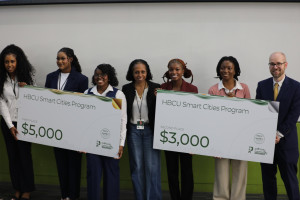
Check presentation during ceremony at Community Tech Day 2026.
Charlotte, NC / April 23, 2026 - Innovation, collaboration, and real-world problem-solving took center stage at Johnson C. Smith University during Community Tech Day on April 23, 2026. The dynamic event brought together students, city leaders, and technology partners to reimagine how Charlotte can work smarter through innovative tech solutions—with students firmly at the center.
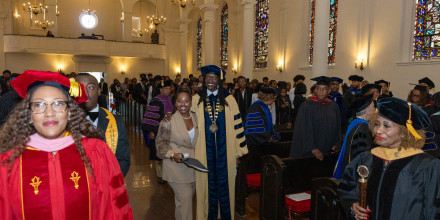
Serving as keynote speaker, President Valerie Kinloch underscored the importance of early exposure to technology and hands-on learning.
“It is great to have students here, K-8 and high school students in the room,” Kinloch said. “Innovation and technology help to build smart cities… When we are able to do the work in the classroom, we are able to do it in the world.”
Hosted in partnership with the City of Charlotte and the Pathway Community Foundation, the event highlighted emerging talent from Historically Black Colleges and Universities (HBCUs), culminating in a high-energy Community Tech Day Pitch Competition. Three student teams presented solutions designed to improve city operations.
“This is really about bringing the community together around technology and innovation,” said Kevin Fomengia, co-founder and Director of Innovation at Pathway Community Foundation. “We’ve partnered with the City of Charlotte and Johnson C. Smith University to create a space where students can build practical solutions—things that can actually be implemented, not just ideas in theory.”
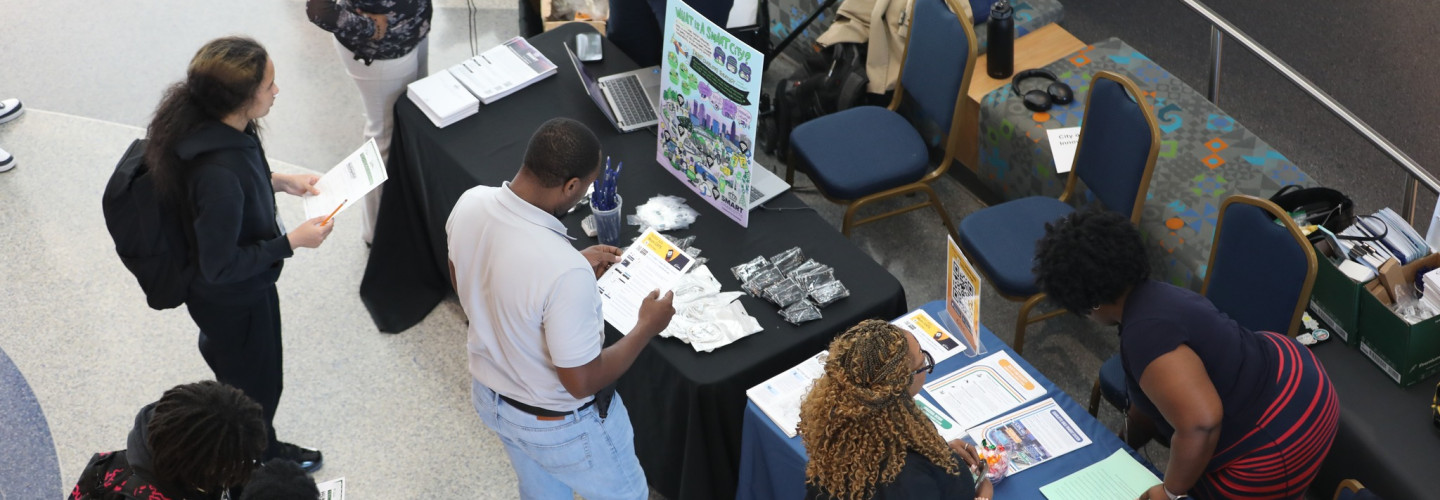
Throughout the day, attendees explored exhibits, connected with local tech leaders, and learned about cutting-edge tools shaping the future of cities. But the centerpiece was the pitch competition, where fellows from the HBCU Smart City Program unveiled projects developed over several months.
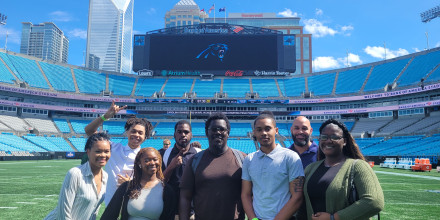
Participants in the competition represented institutions including Johnson C. Smith University, North Carolina Central University, Voorhees University, Benedict College, South Carolina State University, and Coppin State University.
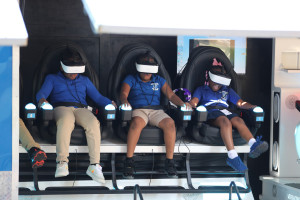
Kids experiencing a VR simulation during Community Tech Day 2026
One standout team featured Precious Durand, a cybersecurity major from Johnson C. Smith University, and Nala Collins, a cybersecurity major from North Carolina Central University.
Durand said the experience pushed her to think beyond the classroom.
“From January through April, we’ve been developing a large language model chatbot system to help create a smarter City of Charlotte,” Durand explained. “This project showed me how technology can directly impact communities.”
Collins echoed that sentiment, emphasizing both the technical and personal growth she gained.
“With the help of AI and data sets, I was able to design a system that supports city departments like streets, water, safety, and waste management,” Collins said. “I’ve learned so much—not just about building large language models, but about Charlotte itself. It’s given me confidence to take on projects like this in the future.”
Their team’s solution tackled a pressing issue faced by city employees: slow and sometimes unreliable access to information. By developing a secure, municipal large language model, the students aim to dramatically reduce the time it takes to retrieve accurate data.
“Right now, it can take up to 18 minutes to locate a single file,” Collins said. “Our system allows workers to ask a question and get a detailed, reliable answer in seconds.”
The project was shaped not only by research, but by firsthand experience. Students visited city offices in Charlotte, met with employees, and toured various districts to explore operations in action.
“That trip really inspired parts of our solution,” Collins added. “I even created an interactive map so users can easily identify which district they’re working in.”
For Fomengia, that level of engagement is exactly the goal.
“Often, pitch competitions focus on theory,” he said. “But here, we’re building real-life solutions. These students are tackling real challenges, and the city has the opportunity to actually use what they’ve created.”
President Kinloch also emphasized the broader impact of centering student success in initiatives like Community Tech Day.
“When we put students at the center of everything we do, that means it is about all of us,” she said. “When our students become successful, that means we become successful, too.”
As the three teams took the stage, the room buzzed with anticipation—not just for who would win, but for what the future could look like if these ideas are brought to life.
Community Tech Day ultimately served as more than a showcase—it was a powerful reminder of what happens when education, innovation, and community come together.
For students like Durand and Collins, it was just the beginning.
“This has been an incredible experience,” Durand said. “It has shown me what’s possible when you combine technology with purpose.”