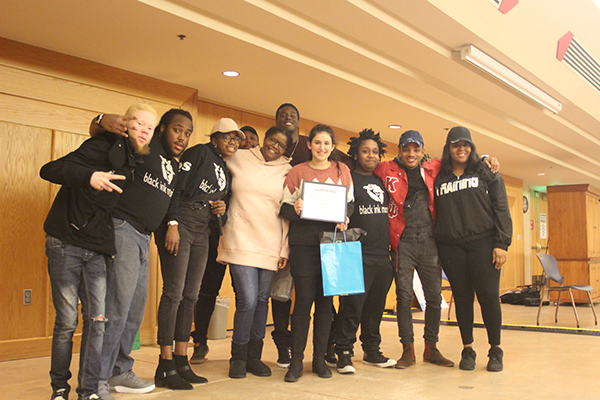
CHARLOTTE, N.C./Feb. 11, 2018 – Members of the Black Ink Monks, Johnson C. Smith University’s oldest non-Greek organization, returned to the American Hebrew Academy (AHA) in Greensboro, N.C. during the Martin Luther King, Jr. holiday weekend, Jan. 11-15, 2018, to teach the high school students how to create and perform spoken word poetry. This trip marked their third invitation in the last five years to the only secular Jewish boarding school in the United States.
The four-day experience, entitled “Spoken Words/Words Spoken: Bypassing the Dangers of the Single Story,” explored the power of stories, both the ones told within families and the narratives promoted by society. Students Sierra Ellis ’18, Drew Emerson ’18, TJ Evans ’18, Brianna Glymph ’18, Diashanna Logan ’18, Tawanda Nyahasha ’20 and Tyler Williams ’18 made the trip.
In addition to current JCSU students, former Black Ink Monks members Tyran Green ’13 and Andrew Smith ’14 participated, as well as Frederick Murphy, who served as JCSU’s director of counseling from 2010-2015, and Dr. Cindy Kistenberg, who serves as faculty advisor to the Monks.
“The experience at AHA was amazing! Just as the kids say they learned from us, I learned from them,” said Smith. “From leading a workshop, to figuring out how to get the kids excited or interested in a subject, to encouraging them to push through anxiety and pour their hearts out on the stage, each day offered new opportunities to learn.”
Smith, who was JCSU’s first film major, now owns a production company and is shooting a documentary film for Murphy.
The weekend also provided an opportunity for the Black Ink Monks and the students at AHA, who represent 35 countries and all branches of Judaism, to learn about themselves and each other.
“AHA taught me invaluable lessons about culture,” said Drew Emerson ’18. “It is great to see the differences, but it’s even more amazing to see the similarities. I taught them about metaphors, similes, and wordplay, and they taught me how to trust my faith, myself, and how to strive through adversity.”
Murphy and Kistenberg gave presentations focused on the transmission of trauma from generation to generation via oral history. Through lecture and discussion, they illustrated how the effects of the Holocaust and slavery continue to impact behavior, and how family stories can have both positive and negative effects generation after generation. The AHA students and Monks shared their own family stories in small groups.
The group attended the Martin Luther King, Jr. Shabbat service on Friday night at Temple Emanuel, Greensboro’s Reform Jewish congregation. Green shared an original poem about the iconic leader to the audience of several hundred, which included congregation members, local educators, politicians and clergy.
That Saturday night, the Monks conducted a workshop with the students, teaching them how to create their own spoken word pieces and perform them. The Monks spent Sunday afternoon working with individual students in preparation for that evening’s open mic night, which traditionally has been the highlight of every visit.
“A lot of students are going through the same situations that all people go through,” Monk T. J. Evans said, “but they rarely have time for an outlet. The open mic allows AHA students far more of an opportunity to share what they have written.”
Ellen Green, assistant director of Institutional Advancement at AHA, noted that spoken word is also an important outlet for the Black Ink Monks. Her praise for the Monks and recognition of their talent is why they have been asked to return next year.
“The Black Ink Monks express themselves in the most passionate and eloquent way,” she said. “I am always impressed by their originality, spontaneity, and ability to let us see their souls through their poetry.”
Nyahasha, a sophomore psychology major, supported her point.
“I have been a writer for a couple of years, but I took poetry for granted. Teaching these kids how to express themselves made me realize I have an outlet most people can only wish for,” he said.