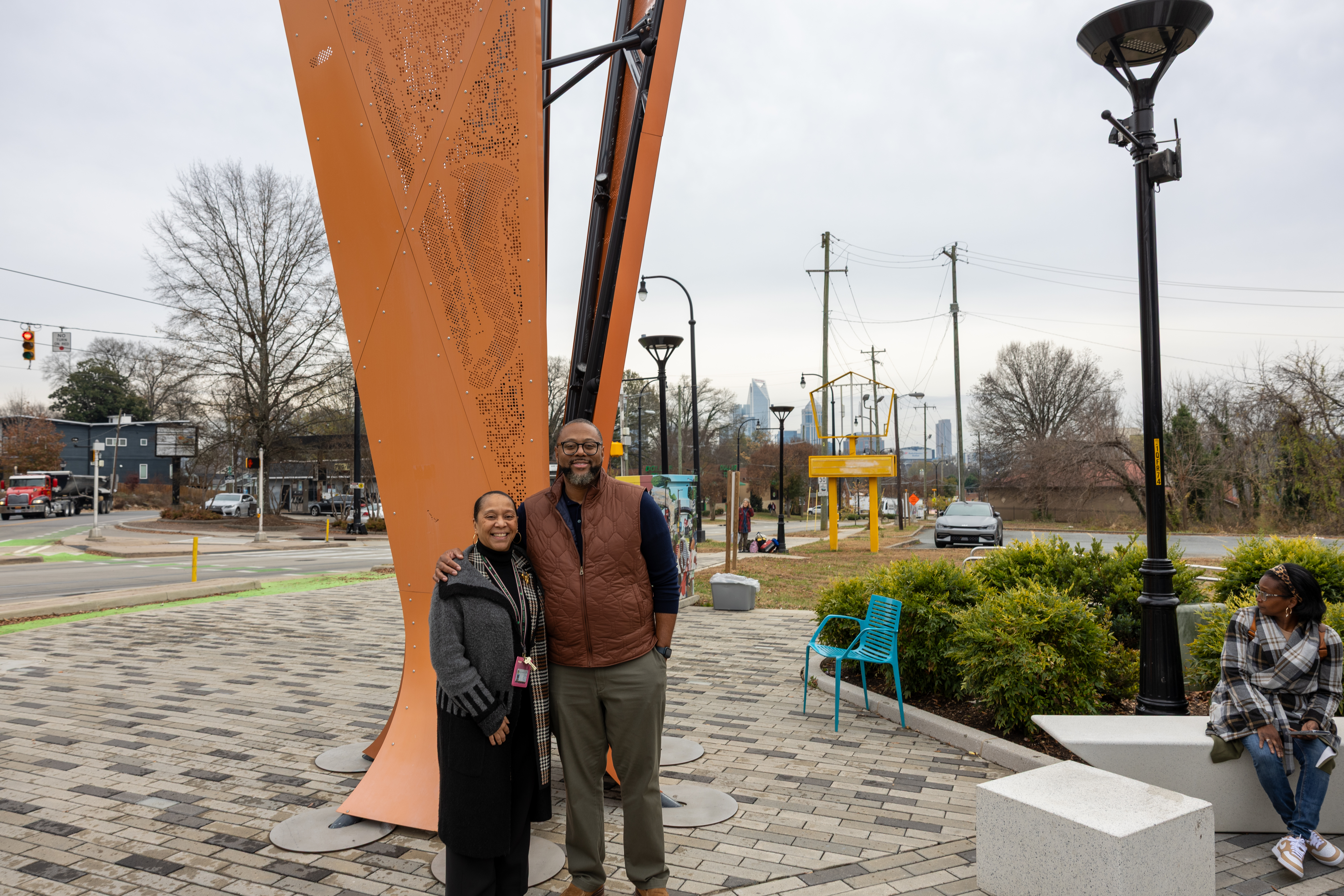
Utley standing next to his sculpture
Just across Five Points from the Gateway Arch on campus is a three-sided, orange-colored metal structure that rises out of the plaza, a piece of public art students, faculty and staff pass every day. The co-creator of that piece, Stacy Utley, came on campus to share the meaning behind it and to share his journey to becoming an artist who creates art for public spaces.
The lecture began in the James B. Duke Library with Utley sharing the story of how he came to this line of work.
“The crazy thing is they don't teach you this in school. They don't teach you how to be a public artist. This is something you have to really kind of learn on your own.”
Utley originally went to school for architecture at North Carolina State University, but just as he started working in the job market and was preparing to get licensed, the Great Recession of 2008 hit, resulting in him losing his job. Instead of continuing his career path, he chose to return to school to pursue a Master of Fine Arts degree at Lesley University.
One of his inspirations to pursue an art degree, beyond his desire to create, was that in his art education he never saw artists who looked like him.
“When they came to the masters, you hear about Picasso, you hear about Rembrandt, you hear about Van Gogh. That came up with every lesson and every curriculum that we did. Occasionally during Black History Month, you may hear about Romare Bearden, Jacob Lawrence or you may hear about Elizabeth Catlett. Rarely, but other than that. When it came to the master artists it was nobody that looked like me,” explained Utley.
He went on to explain that he was blessed to be able to see a few depictions of black art and artists on television citing specifically J.J. Walker from Good Times as being an artist and also seeing art by Black artists being discussed or even shown in the background of other shows.
The inspiration to create also came from his father and uncle who painted, but not professionally, providing inspiration within his home growing up.
When his great-grandmother passed away at the age of 100, he got some of her photos which inspired him to want to tell her story through art. She had been a maid and a day laborer who had worked until she was 90. He began to paint depictions of her taking inspiration from Annie Lee by leaving out the details of the face so that the viewer could imagine themselves or someone they knew in that place and time.
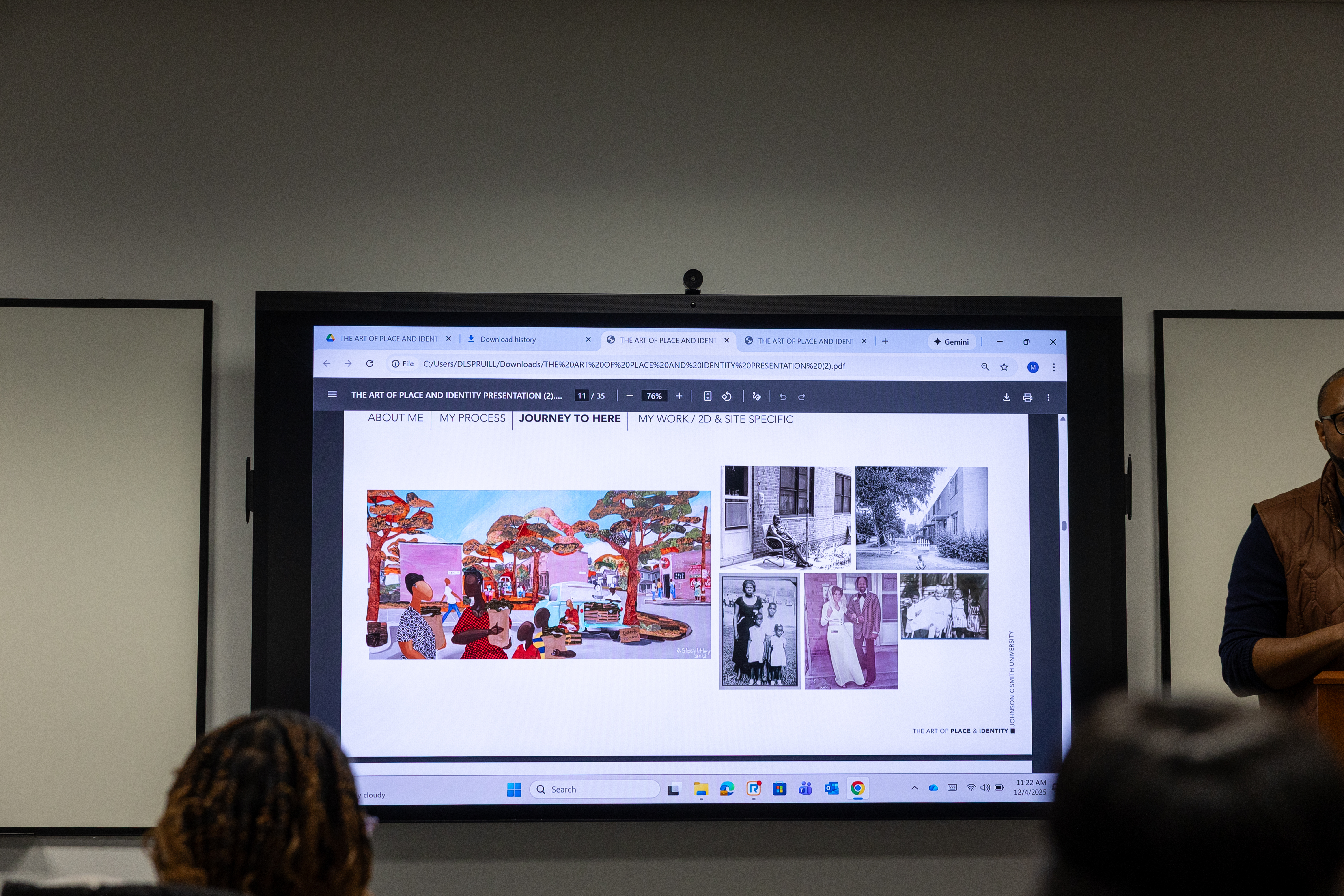
Utley's early work was inspired by photos left to him by his great-grandmother
“What I didn’t realize that I was doing in most of these pieces was telling stories not only about my family but also communities that were no longer there. A lot of these communities that I was telling stories of have been gentrified,” he explained.
During grad school he explored the topic of gentrification more deeply, trying to leverage his knowledge of art and architecture into something that could tell that story in a compelling way. He moved from painting to photography.
Inspired by the models that architects create, he built a small model of a house thinking he could collage it or paint it in some way. He took that model to the Historic Cherry Neighborhood by Dilworth and walked around with it, hoping to find some inspiration.
“I didn’t realize that people were looking out the window at me and calling each other about me walking around,” he said.
Eventually a member of the community came out to confront him, asking him about the model and whether he was an architect. Utley, confused, said that he had gone to school for architecture. She then asked him if her house had been sold because she was renting and had asked the landlord to give her warning before selling, so she could make arrangements before she had to move.
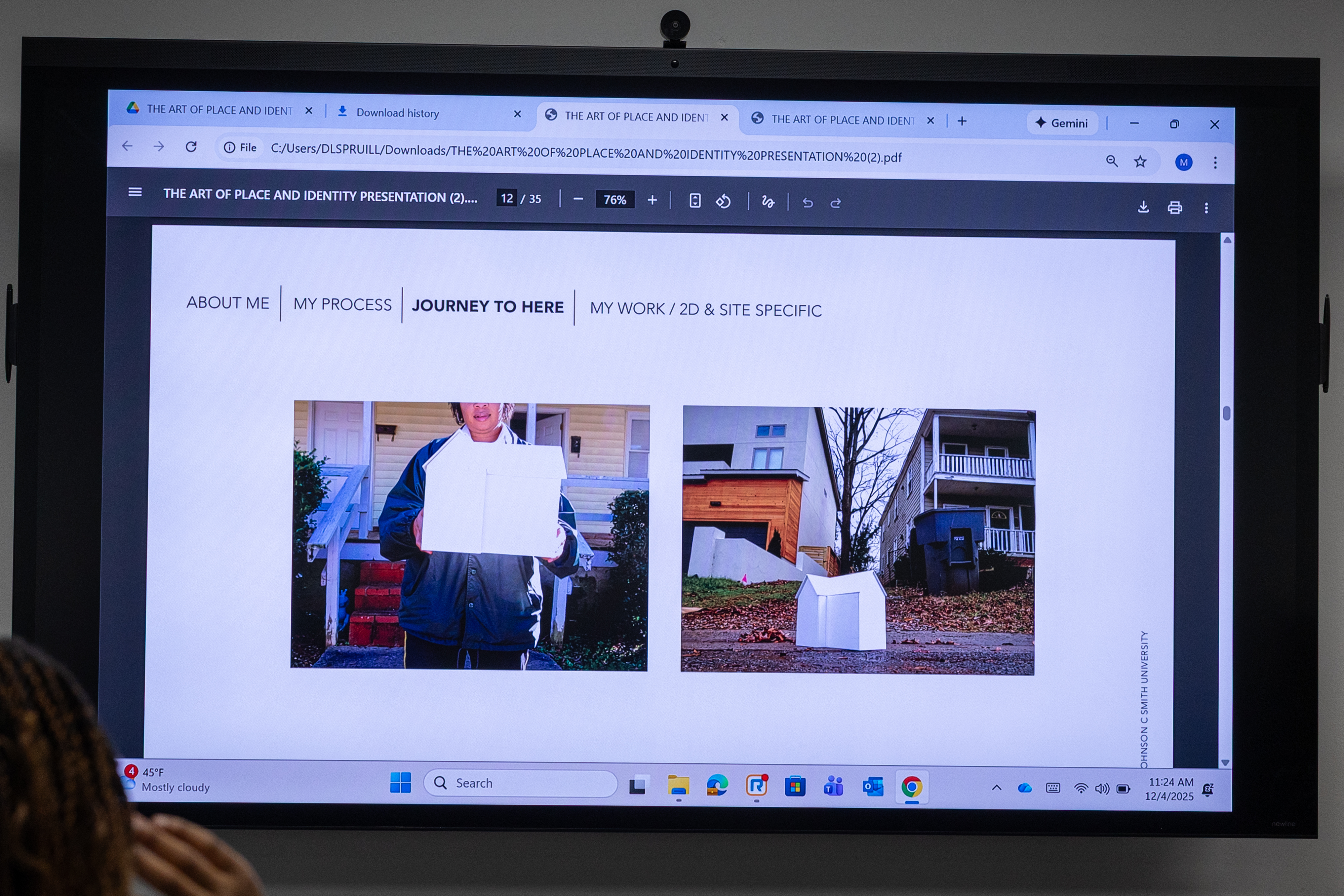
Utley photographed his house model in various in an effort to highlight gentrification
He learned that the neighborhood had been gentrifying so rapidly that residents who had lived there for years were not warned when their homes were sold because the information goes to the property owner, not the renter.
She believed that Utley was carrying a model of the type of home that would be built after their homes had been sold and bulldozed.
This gave him the inspiration he needed to start his project on gentrification, asking her if she could hold the model and allow him to take her photo.
“I did it in a way where the people that I photographed, I cut their head off the top of the frame at the eyes, because that’s basically what’s happened in the community. It’s a loss of identity,” Utley explained.
He photographed the model throughout neighborhoods, juxtaposing it between homes that had been destroyed for McMansions and older homes where people were still living. But he still felt like his art was not big enough to properly tell the story.
Utley’s graduate work inspired him to try to tell bigger stories, moving on to the creation of a mural 120 x 80 inches called “Water,” inspired by a class he taught that took a trip to the 9th Ward in post-Katrina New Orleans.
This piece spoke to Ana Villegas, a junior biology major who was asked to introduce Utley before his lecture.
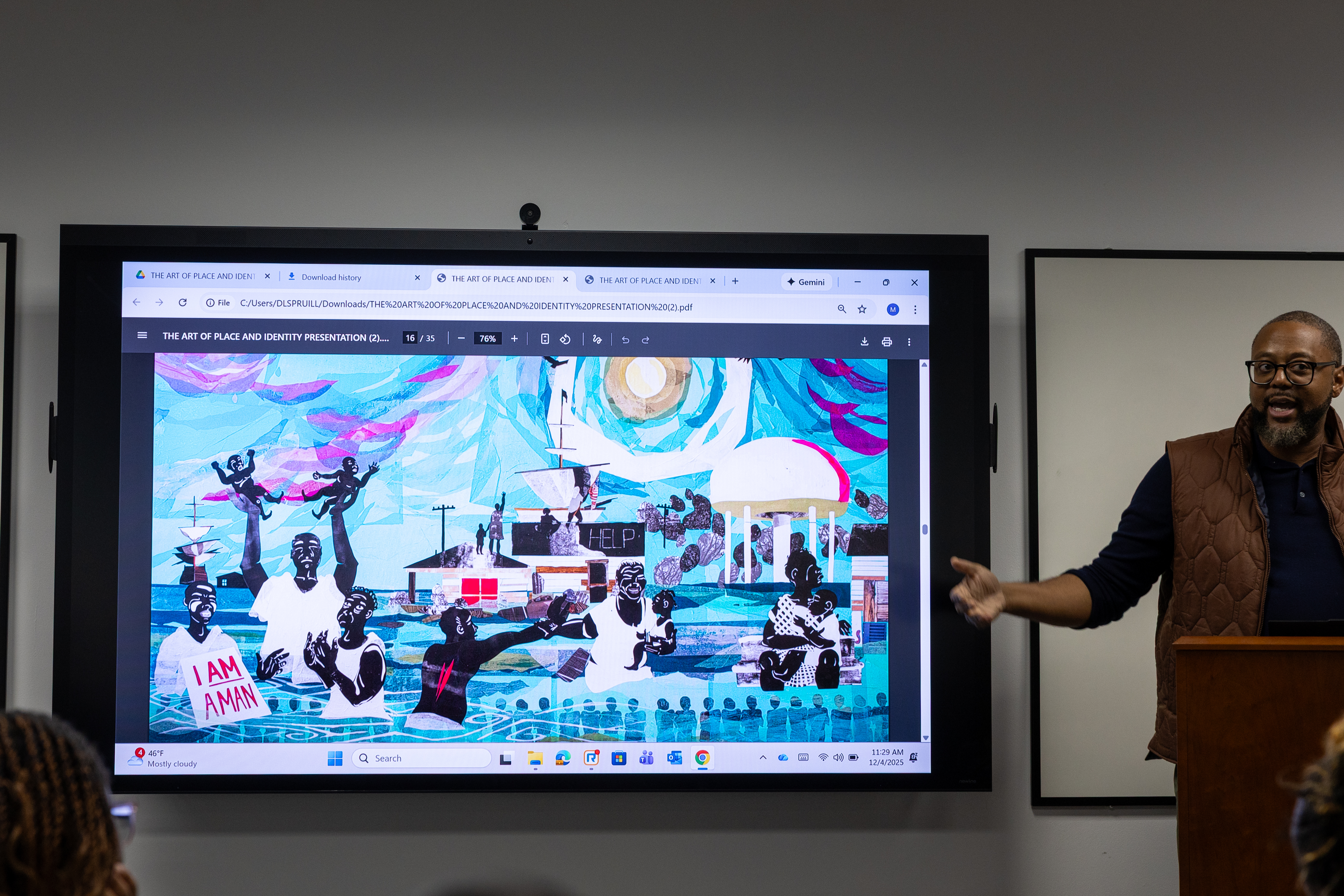
Utley created this piece, "Water," after a trip to New Orleans
“I thought it was really creative and just the visuals—it seemed very appealing. Just the history behind it—how Hurricane Katrina has affected the community. I think that was very interesting to learn more in the background,” Villegas said.
It was one of Utley’s students who suggested he satiate his desire for storytelling and community by trying his hand at public art, noting that his background in architecture would be an advantage. The student pointed out that Utley could create art that lived in the community, art people could walk past and interact with, and still tell the story.
Utley then recapped two of his recent projects: a public park in Raleigh that he is still working on, and the three-sided ochre piece that sits across from campus.
He described the process of creating public art like that piece, saying that initially he had to go through a vetting process, hoping to be shortlisted for an interview and eventually chosen as the person to execute the vision for a common space. He said this process is not necessarily straightforward, because often the organization sponsoring the work has a specific artist in mind.
Utley explained that this was how he got the green light to create the sculpture at Five Points. He had applied for another project and lost the bid, only to get a call that the organizers had liked his submission and had something else coming up, this project, which he applied for and won.
“So, you know, anytime you don’t get it, it leads to something else,” he said.
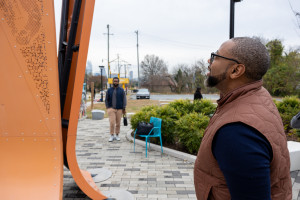
Utley looking at his artwork in Five Points Plaza
The inspiration for the piece came from speaking to the community about what was important to them.
“The first thing you need to do is talk to the elders of the community. Because they know the stories, they know how this community was built, they know what made it work, they know what destroyed the community, and they have still been here building the community,” Utley explained.
He said he was able to connect with and befriend JCSU alumna Dorothy Counts-Scoggins ’64, who helped him connect to the greater community. He took in their feedback on color, material, and how they felt about their community.
What he took away for the Five Points Plaza piece was that it sits at the highest point in this part of Charlotte, and that the surrounding neighborhoods form a patchwork—like a quilt.
Using that as a starting point, he discovered that he wanted to showcase Johnson C. Smith University, a place that is passing the torch on to a new generation. That led to the idea of three sides: past, present and future.
One side is the past: pinholes etched in metal acting as pixels to reveal the famous photo of Counts-Scoggins walking into Harding High School to integrate the school.
“She didn’t want to be on there, but we told her that she was going to be on there anyway,” Utley joked.
The tallest panel represents the present: Biddle Hall, the highest part of the city, needed the tallest part of the artwork.
Finally, the third panel showcases the future, an image that is more abstract but prominently displays the word “Excelsior,” a reference to the Excelsior Club.
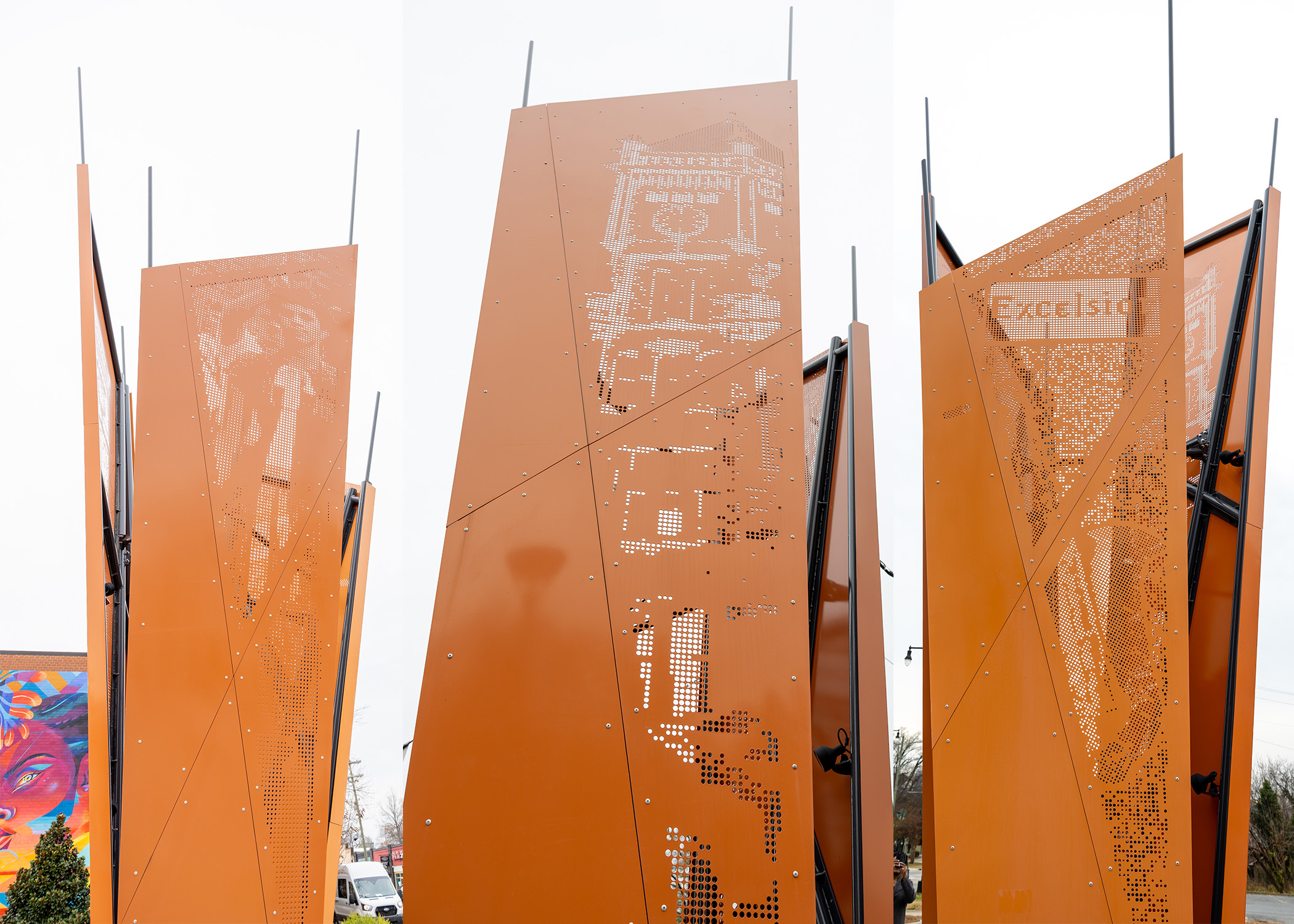
Composite of the three panels of the public sculpture - Past, Present, and Future
“At the time they were trying to tear down the Excelsior Club. There was someone who wanted to come in and build condos or a hotel or something there. So, we decided to have the Excelsior Club be a part of the piece as well because that is a piece of this community,” he explained.
The piece went up during the COVID-19 lockdown and was fabricated by partners he worked with in Denver. Ironically, they were able to install the piece in a community space during a time when the public was being advised to stay home and away from those spaces.
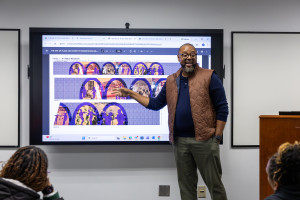
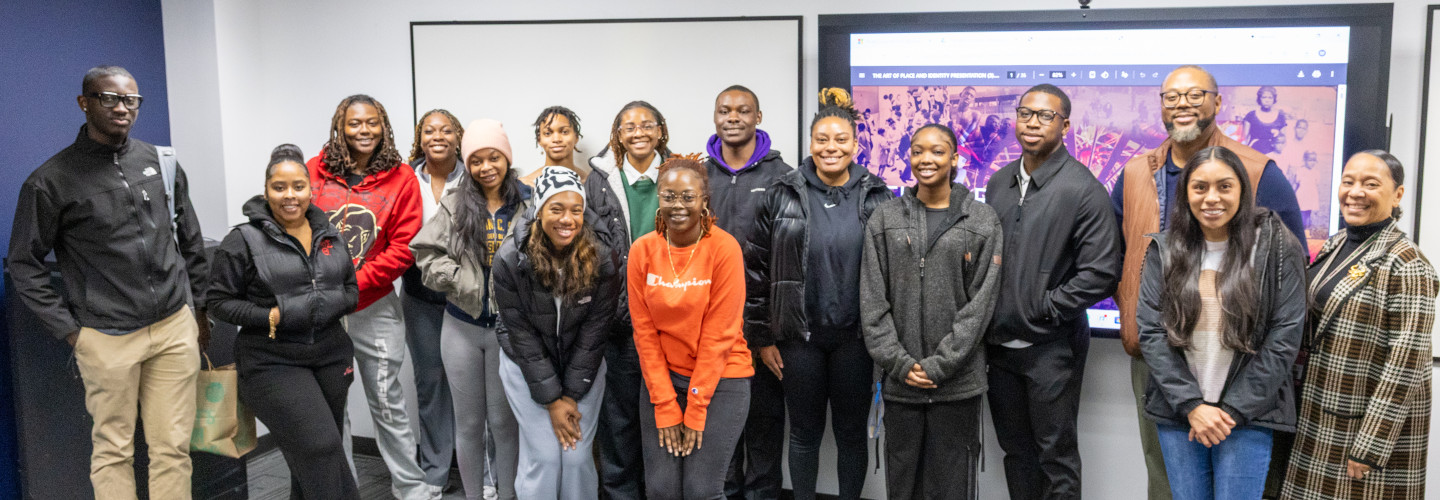
Utley showing his work to students
Looking back, Utley recalls this as one of his favorite pieces because of how seamless and easy it was to accomplish.
“The project came out in like three years and that was just a dream,” he said.
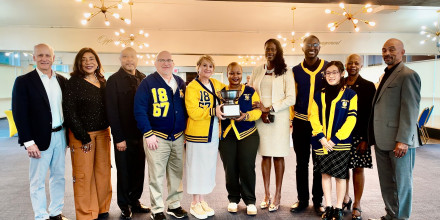
This lecture was sponsored by the McNair Program. Program Director Denise Spruill said that one component of the program is exposing JCSU scholars to arts and culture.
“Bringing Mr. Utley in as a local artist and architect and having this piece directly across from Johnson C. Smith University, which half of them walk past every day and probably don’t notice or understand the connection to JCSU, I think it was a no-brainer,” said Spruill.
She also said she thinks the students will now have a deeper connection and understanding when they see public art.
“As they go through Charlotte, they will be more drawn to more of the public art as they travel through North Carolina—he has pieces throughout the state—but also with his discussion about African American artists in general, they will want to learn more about the topic,” said Spruill.
Villegas agrees with that assessment after participating in the lecture.
“I used to look at public art and not think too much of it. Now I want to discover the meaning behind the pieces. Some pieces look like they don’t have a meaning, but really every piece has a meaning. So now in the future I’m going to do my research on it.”