CHARLOTTE, NC / JUNE 12, 2026 – Johnson C. Smith University partnered with CBRE’s Black Excellence Network Group to host a program to celebrate Juneteenth and connect participants to the local Civil Rights Movement and to allow them to explore the story of one of the cases that helped end the “separate but equal” doctrine for schools.
Held in the James B. Duke Memorial Library, the hybrid event featured a conversation with civil rights leader Talmadge Fair ’61 and Dr. Denise Spruill, director of the Ronald E. McNair Program and adjunct professor at JCSU.
Fair reflected on his experiences as a student leader during the 1960 Charlotte sit-ins at segregated lunch counters in Uptown Charlotte, as well as how JCSU shaped his life and his career and the lessons he learned that still guide him today.
Fair, a native of Winston-Salem, N.C., said that JCSU was not his first choice. He had wanted to go to Howard University, but his mother said that they could not afford it, citing that he had family in Charlotte who would be nearby to support him.
“The best decision she ever made for me,” he said.
Fair also shared how he and nearly 200 of his classmates left campus to participate in sit-ins at segregated lunch counters across the city. He described the fear and stress that they felt while protesting, but also the determination that they had during that time.
“We were afraid, but we were brave,” Fair said. “Our fears had not stopped us at all.”
He credits those around him with helping him through that time, including the mentors who reminded him to keep up his grades and that he and his fellow students were ambassadors of the school. He also credited those who supported their efforts to desegregate the city.
“So, it was those around me, people whose attitude was supportive of me, who did not chastise me, who said, ‘stand up for us, who are standing beside you,’” he explained.
He also noted the support of members of the Presbyterian Church who fed the students after they were not served at the lunch counters because by the time they got back to campus, the cafeteria was closed.
“They shepherded us, they cared for us, and they were white people. It was very clear that this was not about all white people, just some white people who didn’t want us there,” he said.
Fair described how they would demonstrate in the street, separated from the police and the dogs and the crowds against them on opposite sides of the crossbars, but they would always come back to campus for their classes.
“We didn’t miss our classes. We planned it so we didn’t miss our classes,” he explained.
He also said that his mentors, professors and administrators were supportive of him and his cohort’s efforts to bring about change.
“They encouraged us. They gave us the mission to make us who they wanted us to be.”
Fair graduated from JCSU with a degree in sociology, going on to earn a master’s degree in social work before becoming the youngest chief executive officer in Urban League history at the age of 24. He led the Urban League of Greater Miami for more than six decades, becoming one of the nation’s most influential civil rights and community leaders.
Throughout the conversation, Fair emphasized the importance of his education and the role that JCSU played in preparing him for his career.
“Education is key,” Fair said. “My parents understood the value of educating their children. They knew that if they educated their children, their lives would be better.”
When asked what advice he would give to students today, he said he encourages them to be themselves, put down social media, be authentic and pursue their goals.
“With Juneteenth on the horizon, we wanted to share this perspective with our audience, especially our audience at CBRE and share what transpired here in our own city,” said Bryce Perry, Account Operations Director for CBRE. CBRE partnered with JCSU for the event.
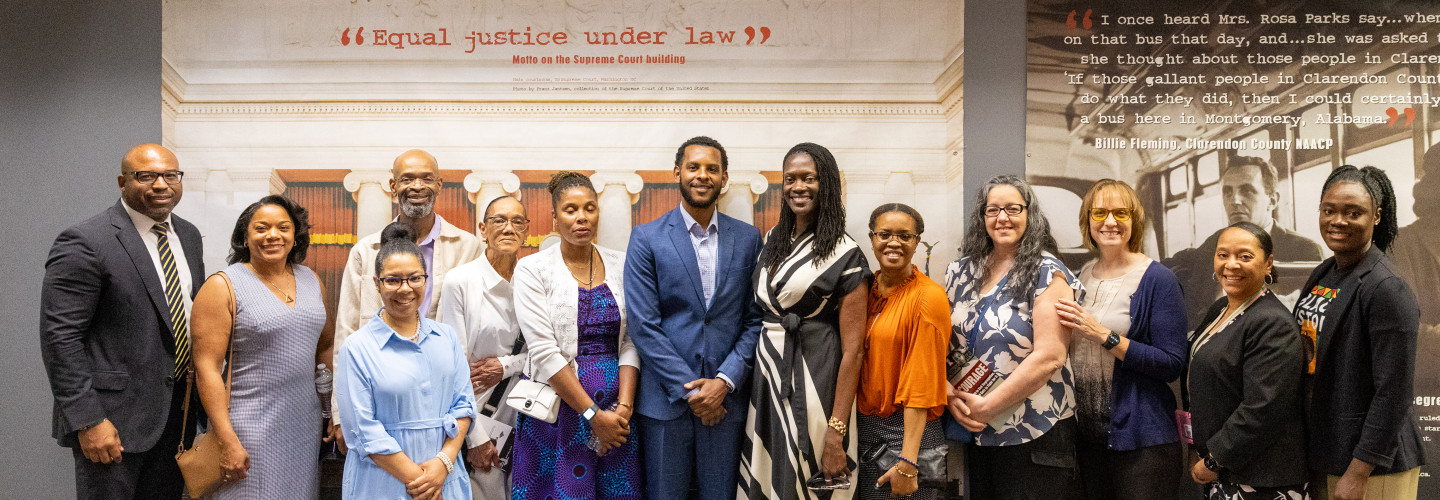
After the interview, online attendees were able to watch a video about the Courage exhibit, which calls the James B. Duke Memorial Library home, while those who attended in person were given a guided tour.
The exhibit highlights the story of J.A. DeLaine and the Black community of Clarendon County, who challenged racial segregation in public education, culminating in the Briggs vs. Elliott case, the first of the five cases that were filed that eventually became part of the landmark case Brown vs. The Topeka Kansas Board of Education, which resulted in the end of segregation in public schools in 1954.
Two of DeLaine’s children, Ophelia DeLaine ’56 and Brumit B.B. DeLaine ’60, earned their degrees at JCSU and B.B. DeLaine participated in the 1960 sit-ins as a student.