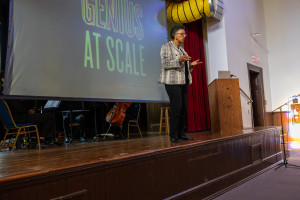
Dr. Hill presenting on the Biddle stage.
CHARLOTTE, N.C. / April 16, 2026 – Dr. Linda Hill, the Wallace Brett Donham Professor of Business Administration at Harvard and Faculty Chair of the Leadership Initiative, was invited to speak on campus by the Charlotte Chapter of the Harvard Business School Alumni Club of Charlotte to share her work on leadership and innovation.
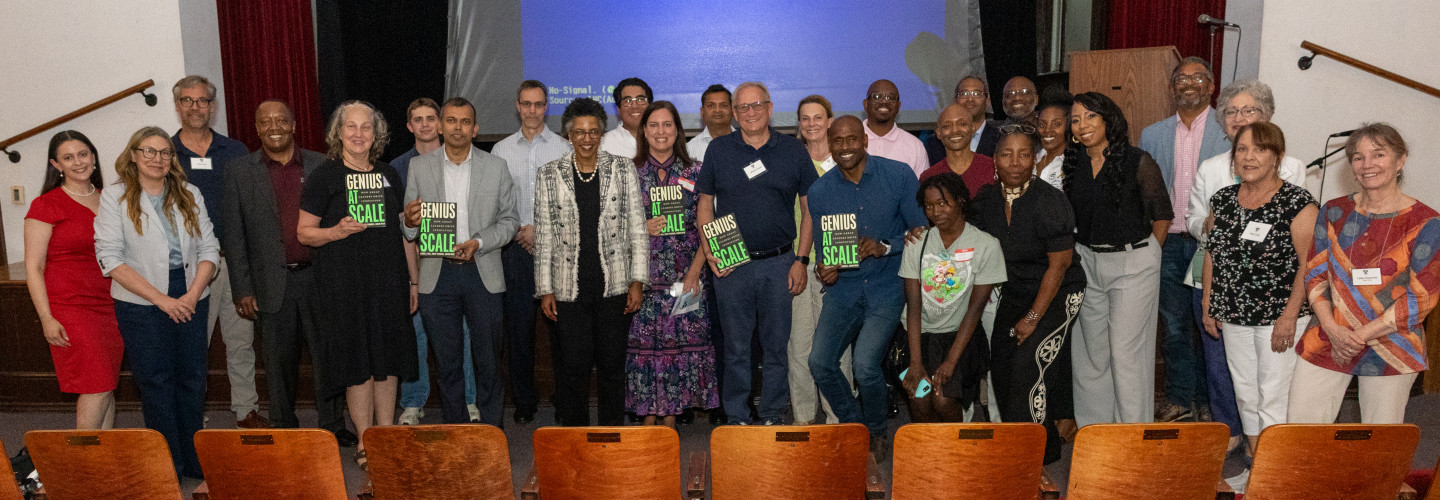
The event, held in Biddle Hall’s Gambrel Auditorium, presented an opportunity for attendees to network and engage with Hill’s ideas, which focus on shaping leadership at the highest levels of business and organizations.
The talk was originally scheduled at another venue, according to organizer J. Vin Vera, president of the alumni club, but was moved to JCSU’s campus due to a scheduling conflict. Vera explained that he was excited to be able to bring the lecture to an HBCU, as Hill has been active in that space.
Hill has authored several books on leadership and signed copies of her latest book, Genius at Scale: How Great Leaders Drive, after her lecture.
Her remarks included case studies about leaders, some of whom she taught in the classroom. She outlined the challenges they faced and the challenges they overcame, including studies of managers from Disney/Pixar, the Cleveland Clinic, Proctor & Gamble, and the leader of one of the teams at Pfizer responsible for getting the COVID-19 vaccine through clinical trials for approval.
She explained that often generating ideas is only part of the work. The hardest work can come from putting together an organization that can effectively and capably turn an idea into reality.
Drawing from her research and expertise in advising corporations, she explained that innovation often comes from creating cultures where people are able to collaborate, solve problems and move ideas from concept to execution. Her studies show that to be effective, leaders sometimes need to make difficult and unpopular choices, such as moving people around in an organization or knowing when to stop working on an idea because it can go no further.
“Many companies told us that it’s not that we don’t know how to generate innovative ideas. The problem is that we don’t know how to turn them into reality,” she explained.
Throughout the conversation, Hill emphasized that to be a leader in today’s world means that you must be able to lead with uncertainty. Leaders do not have the luxury to wait for perfect information, so to be effective, they must be able to adapt quickly, make quick decisions and learn from what they have done.
“Frankly, it is not enough if you want to build an organization that can be agile and sustain its success in a world that we live in right now,” she explained. “Some of the change required is kind of clear, but a lot of it we don’t know. It really is the case that it’s not exactly sure. We’re not even sure what the destination is or how you’re going to get there.”
In that kind of environment, people at every level are encouraged to think critically, contribute ideas and help shape solutions.
“Leadership does matter, and what they do makes a difference, and not only does what they do make a difference to the people who work in the organization, but also what they can do for their customers.”
Hill also discussed the importance of collaboration when innovating. Her research shows that bringing people together with different perspectives and creating conditions where disagreement is productive can help further business goals as opposed to dividing a team.
“What you’re trying to do is create a space for people who have different points of view because you rarely get innovation without diversity of thought,” said Hill. “And when you have diversity of thought, you’re going to have conflict. You have the potential for conflict.”
In order to create a space where this can happen, leaders need to create spaces where rules of engagement are created that allow workers to feel psychologically safe. Places where trust and shared purpose help teams work through challenges and make better decisions together.
Vera said that he plans on continuing a relationship between the University and the Harvard Business School Alumni Club.
“This is not just one short deal; this is a lasting relationship,” he explained.