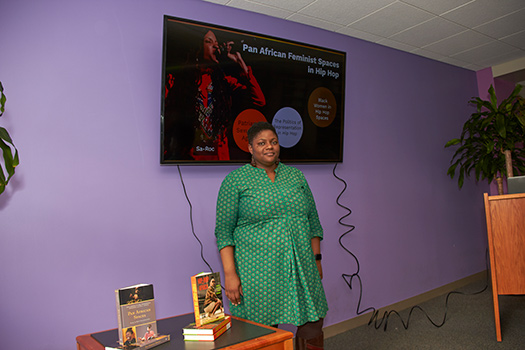
CHARLOTTE, N.C./Mar. 27, 2019 – JCSU celebrated the end of International Women’s Month with a lecture about how feminism is represented in hip hop from a pan African viewpoint from one of our alumna.
Dr. Msia Clark ‘98, associate professor in the department of African studies at Howard university spoke to a crowd in James B. Duke Library on Tuesday, March 25. Her work focuses on popular culture, migration and culture in Africa.
She has published several books about hip hop in Africa and produces the Hip Hop African blog and monthly podcast at hiphopafrican.com. She has forged her research into a course she has developed, Hip Hop and Social Change in Africa, and classifies herself as both an academic and an activist.
Clark began her talk by discussing how much coming back to JCSU to lecture means to her.
“A whole lot of what I became as a person, as an activist as a scholar really got its foundation here at Johnson C. Smith University,” she said.
She shared an anecdote about her time at JCSU to highlight the importance of sisterhood and being her sister’s keeper that involved her friends in her residence hall about which sorority to rush and the relationships that she had forged with them.
“These Greek organizations were founded for black women, by black women, and knowing that black women have to navigate racism and sexism, and these other “isms,” and I’ve always found hip hop to be a hostile place for women, so being able to have spaces carved out within the culture by women has been really a place for women to protect themselves from the harsh realities of hip hop,” said Clark.
From there Clark highlighted the difference between media representations of women, especially black women, where women are often set against each other versus the reality where women tend to help each other and there is a sisterhood.
“I chose to look at feminism and hip hop through a pan African lens because of the shared experiences of women globally,” explained Clark. “We often overlook it and focus instead on looking on our differences.”
She pointed out that, no matter where in the world you are from, black women face a higher amount of gender-based violence, navigating patriarchal systems and ending up with unequal access to resources. These global experiences are expressed through female hip hop artists and how they express themselves.
“I’ve always been aware that hip hop didn’t always love me,” said Clark, referring to the ways in which women have often been portrayed in hip hop lyrics, generally from a male patriarchal viewpoint. Even though the lyrics may be brilliant, they are also horrible for gender politics.
“I like this song, but I’m also aware that throughout this album I’m being disrespected,” said Clark.
Women as hip hop artists are pushing back against cultural norms and, consciously or unconsciously, are also creating diverse representations of black women according to Clark. This also means that they work in a system that is generally run by men and they often are deprived equal access to resources.
According to her research it also means these female black artists often self-police their dress in order to prevent sexual harassment so that they can be taken seriously as artists and not for how pretty or sexual they are.
She specifically pointed out the wave of female black hip hop artists coming up in South Africa and how they are resisting playing the role of video vixen and the importance of representation in the culture.
Clark pointed out that representation in culture molds how an ethnicity can be seen broadly. That if black males are seen as gangbangers or athletes that is how they will be more broadly thought of.
“If you are not around black men and you encounter a black man your first thought is to rely on all these representations that you have seen of black men,” she emphasized.
If these are negative, then you will naturally resist feeling vulnerable and act accordingly. That’s why it is so important for representations in the culture that counter that narrative and change the point of view. Women emcees do this through their own lens and perspective and it allows them to create their own narratives to counter those presented by male artists.
“Imagine what your view of women would be if there were no women rappers, if all you had were men’s representations of what women were good for, what they were useful for,” explained Clark.
When women are allowed a voice, they present themselves as having agency, complex relationships with motherhood, with men and with other women. Clark also points out that women both in Africa and the US are dealing with issues of mental health and stress.
Another way female artists differ, according to Clark’s research, is in representations of sexuality and, in so doing, they challenge patriarchy and attempts to police their body and they are able to present their own sexual gender identities.
During her lecture Clark pointed out that she has also had to navigate these challenged spaces. She was frank with her struggles both with labeling female artists as “femcees” as opposed to “emcees,” until challenged by one of the artists she was studying and her struggle with dealing with gender fluidity, explaining that it does not come as naturally as it seems to for her students, most likely because of the time that she grew up and the culture she was exposed to.
If you would like to learn more about Clark’s ideas, her books are available in the library.